Computer Software selected work

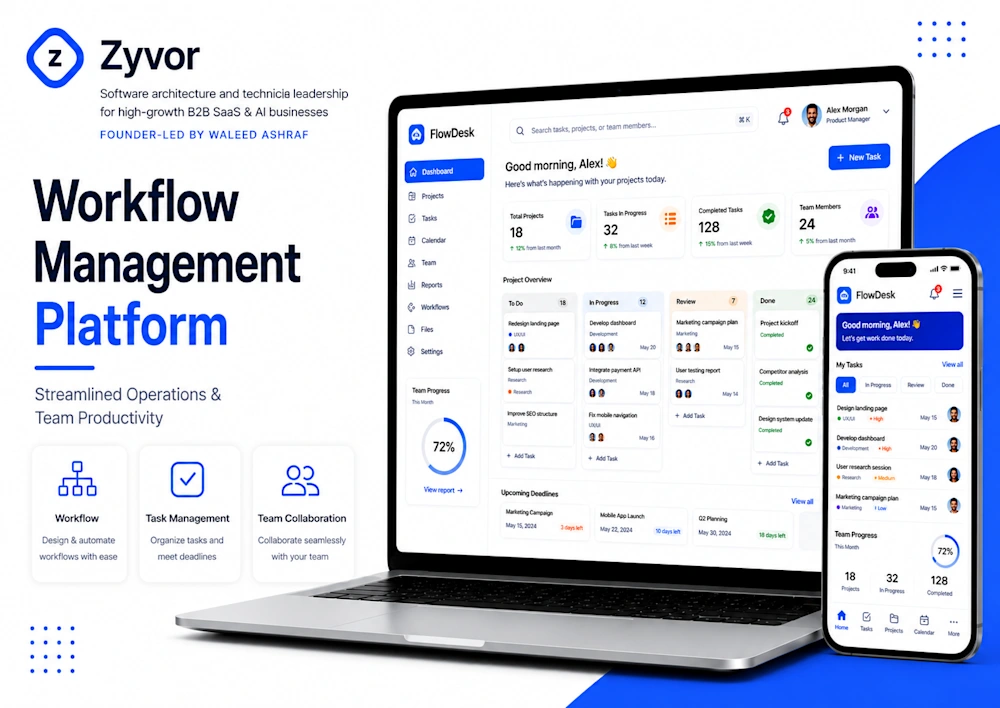
WorkFlow Management Platform

Project and task management platform designed for kanban workflows, team collaboration, deadline tracking, progress reporting, and operational visibility across distributed teams.

WorkFlow Management Platform project cover
Sarwar GroupAug 1, 2022 – Nov 30, 2022

measurable outcomes

4 project management tools consolidated into 1. Cross-unit project coordination time reduced 70%. Project setup time from 2+ hours to 15 minutes using templates
Unrecorded task assignments dropped from 30% to zero. Missed deadlines reduced from 25% to 8%. Dependency-based rescheduling preventing 40+ cascade failures per month
Manual status reporting eliminated (15+ hours/week saved across all PMs). Executive team seeing real-time portfolio health instead of weekly static reports. At-risk projects identified 2 weeks earlier on average
Concrete result: Platform managing 120+ active projects across 6 business units. Estimation accuracy from ±40% to ±15%. Executive team making resource decisions with real data. 4 legacy tools decommissioned

problem

What had to change.

6 business units using 4 different project management tools. Cross-unit projects required manual status updates copied between systems. A project spanning 2 business units had 2 separate task boards with no synchronization
Task assignment was informal. Managers assigned work through Slack messages and verbal conversations. 30% of tasks had no written record of who was responsible, what the deadline was, or what "done" looked like
Deadline tracking was manual. Project managers maintained personal spreadsheets of deadlines and sent reminder emails. Missed deadlines averaged 25% across the organization. Nobody knew a deadline was missed until the project manager noticed
Progress reporting consumed 15+ hours per week across all project managers. Each PM compiled their own status report in their own format. The executive team received 6 different reports with no standardized metrics
Resource allocation was invisible. Managers couldn't see who was overloaded and who had capacity. Work distribution was uneven: some team members had 3x the task load of others in the same role
Historical project data was scattered across 4 tools and countless email threads. Post-project reviews were based on memory. Estimating timelines for new projects was guesswork because there was no historical baseline

execution

The implementation lanes behind the project.

One platform. Every business unit. Every project.

Unified Project Workspace

  • Standardized project structure with configurable workflows per business unit: kanban boards, timeline views, and list views all showing the same underlying data
  • Cross-unit project support: a single project can span multiple business units with shared task boards, unified timelines, and consolidated reporting
  • Project templates for recurring project types with pre-configured task lists, role assignments, and milestone schedules
4 project management tools consolidated into 1. Cross-unit project coordination time reduced 70%. Project setup time from 2+ hours to 15 minutes using templates

Every task has an owner, a deadline, and a definition of done.

Structured Task Management

  • Task creation with required fields: assignee, deadline, priority, and acceptance criteria. No more ambiguous assignments
  • Task dependencies with automatic timeline adjustment: when a predecessor task slips, dependent tasks reschedule automatically with notifications to affected assignees
  • Subtask decomposition allowing complex tasks to be broken into trackable steps with individual progress tracking
Unrecorded task assignments dropped from 30% to zero. Missed deadlines reduced from 25% to 8%. Dependency-based rescheduling preventing 40+ cascade failures per month

Know where every project stands. Right now.

Real-Time Progress Visibility

  • Live project dashboards showing task completion rates, milestone progress, timeline adherence, and blocker counts per project
  • Organization-wide portfolio view showing all active projects, their health status (on track, at risk, behind), and resource allocation across business units
  • Automated status reports generated weekly with configurable metrics, eliminating manual report compilation
Manual status reporting eliminated (15+ hours/week saved across all PMs). Executive team seeing real-time portfolio health instead of weekly static reports. At-risk projects identified 2 weeks earlier on average

See who's overloaded and who has capacity.

Resource Allocation Intelligence

  • Workload heatmap showing task count, estimated hours, and deadline density per team member across all projects
  • Capacity planning: managers see available capacity per team member before assigning new work, preventing overallocation
  • Utilization reporting showing actual vs. planned effort per person, team, and business unit
Work distribution variance reduced 55% (less overloading, less underutilization). Resource conflicts identified before they cause delays. Team satisfaction scores improved 22% (less burnout from uneven workloads)

Learn from every project. Estimate better next time.

Historical Project Intelligence

  • Project archive with full task history, timeline data, actual vs. estimated durations, and post-project notes
  • Estimation benchmarks: when creating a new project, the system suggests timelines based on similar historical projects with actual completion data
  • Trend analysis showing organizational patterns: which project types consistently run over, which teams deliver on time, and where estimation accuracy is improving or declining
Project estimation accuracy improved from ±40% to ±15% using historical benchmarks. Post-project reviews based on data instead of memory. Organizational learning captured systematically for the first time

Make the implementation usable after launch.

Architecture Handoff and Operating Model

  • Documented the key architecture decisions, tradeoffs, and ownership boundaries behind the work.
  • Connected delivery lanes to support, operations, and future product iteration instead of treating launch as the finish line.
  • Gave the team a clearer operating model for scaling the product without recreating the same bottlenecks.
Platform managing 120+ active projects across 6 business units. Estimation accuracy from ±40% to ±15%. Executive team making resource decisions with real data. 4 legacy tools decommissioned

project depth

More context behind the WorkFlow Management Platform work.

Each selected project is read through business pressure, architecture tradeoffs, delivery sequencing, team operating model, role coverage, and stack fit so the case study stays useful for founders, CTOs, and product leaders evaluating similar work.

business pressure

Why the work mattered

The organization had 200 people working hard with no shared system to coordinate, track, or learn from their work. The project started from a real operational constraint, not a decorative rebuild, which made the architecture work accountable to business movement.

architecture pressure

PostgreSQL with recursive CTEs for task dependency graphs

Task dependencies form directed acyclic graphs. Recursive CTEs traverse dependency chains to calculate critical paths, identify cascade impacts, and detect circular dependencies at the database level. No application-layer graph traversal needed

implementation priority

Unified Project Workspace

4 project management tools consolidated into 1. Cross-unit project coordination time reduced 70%. Project setup time from 2+ hours to 15 minutes using templates

operating change

What changed for the team

4 project management tools consolidated into 1. Cross-unit project coordination time reduced 70%. Project setup time from 2+ hours to 15 minutes using templates

role coverage

Leadership and engineering coverage

The work called for software architect, technical lead, backend engineer, full-stack engineer, api engineer coverage, connecting strategy, implementation, and delivery quality instead of treating them as separate tracks.

stack fit

Technology choices in context

Next.js, React, PostgreSQL, Redis, Node.js, TypeScript were part of the delivery context, but the value came from how the stack supported maintainability, scalability, and a stronger path from architecture to production.

architecture decisions

Technical choices that mattered.

PostgreSQL with recursive CTEs for task dependency graphs

Task dependencies form directed acyclic graphs. Recursive CTEs traverse dependency chains to calculate critical paths, identify cascade impacts, and detect circular dependencies at the database level. No application-layer graph traversal needed

Redis for real-time collaboration state

Multiple users editing the same project board simultaneously need real-time updates. Redis pub/sub broadcasts task changes to all connected clients. Redis also caches frequently accessed project summaries for sub-50ms dashboard loads

React with optimistic updates for task interactions

Drag-and-drop task management needs to feel instant. Optimistic updates move tasks immediately in the UI while the server confirms in the background. Conflict resolution handles the rare case where two users move the same task simultaneously

Node.js with WebSocket for live collaboration

Project boards with 5-10 simultaneous users need real-time synchronization. WebSocket connections push task updates, comments, and status changes to all connected clients without polling. Graceful degradation to SSE for restricted network environments

operating model

Architecture changes were tied directly to how the software business would operate after launch.

4 project management tools consolidated into 1. Cross-unit project coordination time reduced 70%. Project setup time from 2+ hours to 15 minutes using templates
Unrecorded task assignments dropped from 30% to zero. Missed deadlines reduced from 25% to 8%. Dependency-based rescheduling preventing 40+ cascade failures per month
Platform managing 120+ active projects across 6 business units. Estimation accuracy from ±40% to ±15%. Executive team making resource decisions with real data. 4 legacy tools decommissioned

results

What changed after the work.

4 project management tools consolidated into 1. Cross-unit project coordination time reduced 70%. Project setup time from 2+ hours to 15 minutes using templates
Unrecorded task assignments dropped from 30% to zero. Missed deadlines reduced from 25% to 8%. Dependency-based rescheduling preventing 40+ cascade failures per month
Manual status reporting eliminated (15+ hours/week saved across all PMs). Executive team seeing real-time portfolio health instead of weekly static reports. At-risk projects identified 2 weeks earlier on average

Week 1

Platform deployed across first 2 business units. 50+ active projects migrated from Trello and Asana. Unified task structure enforcing assignee, deadline, and acceptance criteria on every task

Week 3

All 6 business units onboarded. Cross-unit projects running on shared boards for the first time. Automated status reports replacing manual compilation

Month 1

Missed deadlines dropping from 25% toward 12%. Resource allocation heatmap revealing workload imbalances. 15+ hours/week of manual reporting eliminated

Month 2

Missed deadlines at 8%. Work distribution variance reduced 55%. Historical project data accumulating for estimation benchmarks

Month 4

Platform managing 120+ active projects across 6 business units. Estimation accuracy from ±40% to ±15%. Executive team making resource decisions with real data. 4 legacy tools decommissioned

Final outcome

Platform managing 120+ active projects across 6 business units. Estimation accuracy from ±40% to ±15%. Executive team making resource decisions with real data. 4 legacy tools decommissioned

buyer relevance

Why this project belongs in Zyvor software architecture work.

Software architecture signal

WorkFlow Management Platform shows how architecture decisions can move from implementation detail into business leverage for computer software teams.

Technical leadership signal

The work connects software architect, technical lead, backend engineer responsibilities with delivery clarity, execution confidence, and a cleaner operating model.

Scale-readiness signal

Platform managing 120+ active projects across 6 business units. Estimation accuracy from ±40% to ±15%. Executive team making resource decisions with real data. 4 legacy tools decommissioned

What kind of business is WorkFlow Management Platform most relevant for?

This project is most relevant for computer software and computer software teams that need stronger software architecture, clearer technical direction, and more reliable execution as product or operational complexity increases.

What did Zyvor focus on in this selected work?

I built a unified project and task management platform that standardizes workflows across all business units, provides real-time visibility into progress and resource allocation, and captures historical data for better future planning. The work was framed around practical architecture decisions, delivery ownership, and measurable business outcomes rather than advisory language alone.

How does this support Zyvor's software architecture consulting focus?

WorkFlow Management Platform supports Zyvor's focus on B2B SaaS and AI software architecture consulting by connecting system design, technical leadership, scalability, and execution quality to a concrete project outcome: Platform managing 120+ active projects across 6 business units. Estimation accuracy from ±40% to ±15%. Executive team making resource decisions with real data. 4 legacy tools decommissioned

What kind of technical leadership problem does this represent?

It represents the point where delivery pressure, architecture ownership, and business expectations start converging. In work like WorkFlow Management Platform, technical leadership is not only about writing code; it is about choosing the right sequence, reducing ambiguity, and giving the team a clearer execution model.

What should a founder or CTO notice in this project?

A founder or CTO should notice the link between the business problem and the technical system underneath it. The most important signal is not a tool choice by itself; it is how the architecture, implementation lanes, and operating model support a measurable business result.

Does this kind of work require a full rebuild?

Not always. The right engagement depends on where the risk sits. Some projects need a focused architecture reset, some need modernization, and some need new product development. Zyvor frames the work around the smallest practical path to stronger scalability, reliability, and delivery confidence.

Decision context

The organization had 200 people working hard with no shared system to coordinate, track, or learn from their work. That business pressure shaped the architecture choices, implementation order, and operating model behind the work.

Delivery leverage

4 project management tools consolidated into 1. Cross-unit project coordination time reduced 70%. Project setup time from 2+ hours to 15 minutes using templates This is the kind of delivery leverage Zyvor looks for: fewer bottlenecks, clearer ownership, and better execution rhythm.

Architecture handoff

The project covered Next.js, React, PostgreSQL, Redis, Node.js while keeping the handoff focused on maintainability, future change, and leadership clarity instead of isolated implementation tasks.

Best-fit conversation

A similar engagement usually starts with the current bottleneck, the architecture decision that feels stuck, and the business risk that is becoming harder to ignore.