Computer Software selected work

Integration & Automation Hub

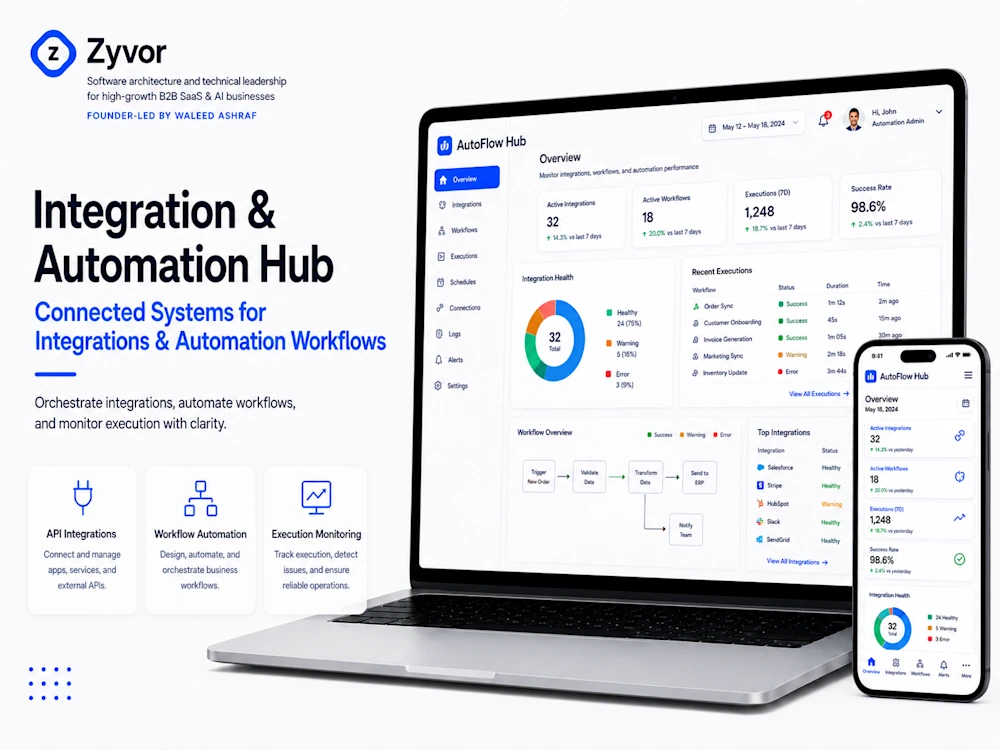
API orchestration platform built with centralized integrations, webhook processing, retry queues, workflow automation, failure alerts, and monitoring for reliable connected business operations.

Integration & Automation Hub project cover
Sarwar GroupJul 1, 2024 – Oct 31, 2024

measurable outcomes

65 point-to-point scripts replaced with managed connectors. New employee provisioning across all systems dropped from 3 days to 15 minutes. Integration maintenance from 20+ hours/week to under 2
Data loss from missed webhooks eliminated. Integration reliability improved from ~85% to 99.7%. Dead letter queue catching and surfacing failures that previously went undetected for weeks
200+ Zapier zaps migrated to managed workflows. Monthly automation costs dropped from $4,000+ to under $200 (infrastructure only). Complex workflows that hit Zapier limitations now running without workarounds
Concrete result: All 65 scripts decommissioned. 40+ tools connected through unified platform. Integration reliability at 99.7%. Zero data loss incidents since launch

problem

What had to change.

40+ SaaS tools across 6 business units with zero centralized integration. When a new employee was added in HR, someone manually created accounts in 5 other systems. Average time to fully provision a new employee across all systems: 3 days
Point-to-point integration scripts numbered 65+, written by different developers over 4 years, in 3 different languages, with no documentation. When a script broke, finding the right person to fix it took longer than the fix itself
Webhook processing was fire-and-forget. If a receiving system was down when a webhook fired, the data was lost. No retry logic, no dead letter queues, no failure notifications. Data inconsistencies discovered days or weeks later
No visibility into integration health. The IT team learned about failures from business users complaining about missing data. Average time from integration failure to detection: 26 hours
Workflow automation was Zapier-based with 200+ zaps across 6 business units. Monthly Zapier costs exceeded $4,000, and complex workflows hit platform limitations requiring workarounds that added fragility
Data reconciliation between systems was a monthly ritual. Finance spent 4 days per month reconciling data between the ERP, CRM, and billing systems. Discrepancies averaged 8% of records

execution

The implementation lanes behind the project.

40+ tools connected through one orchestration hub.

Centralized Integration Layer

  • Pre-built connectors for major SaaS platforms (Salesforce, HubSpot, Xero, BambooHR, Slack, Microsoft 365) with standardized data mapping and transformation
  • Universal API adapter for custom and legacy systems with configurable authentication, request/response mapping, and error handling
  • Bi-directional sync with conflict resolution: when the same record is updated in 2 systems simultaneously, configurable rules determine which version wins
65 point-to-point scripts replaced with managed connectors. New employee provisioning across all systems dropped from 3 days to 15 minutes. Integration maintenance from 20+ hours/week to under 2

No more lost data when a system is temporarily down.

Reliable Webhook Processing

  • Webhook ingestion with immediate acknowledgment and async processing. Incoming webhooks stored durably before processing, ensuring zero data loss
  • Configurable retry policies per integration: exponential backoff, maximum retry count, and dead letter queue for permanently failed deliveries
  • Webhook replay capability: re-process any historical webhook with one click for debugging or recovery after downstream system outages
Data loss from missed webhooks eliminated. Integration reliability improved from ~85% to 99.7%. Dead letter queue catching and surfacing failures that previously went undetected for weeks

Replace 200 Zapier zaps with workflows you can actually debug.

Visual Workflow Automation

  • Drag-and-drop workflow builder with conditional branching, loops, data transformation, and multi-step error handling
  • Workflow templates for common patterns: employee onboarding across systems, invoice-to-payment reconciliation, lead-to-opportunity sync, and cross-system notifications
  • Execution history with step-by-step replay showing input/output at each node, making debugging a 2-minute task instead of a 2-hour investigation
200+ Zapier zaps migrated to managed workflows. Monthly automation costs dropped from $4,000+ to under $200 (infrastructure only). Complex workflows that hit Zapier limitations now running without workarounds

Know about failures in seconds, not days.

Real-Time Integration Monitoring

  • Integration health dashboard showing real-time status, throughput, error rates, and latency for every connection
  • Configurable alerting: Slack, email, and SMS notifications on integration failures with full context (which system, which record, what error)
  • SLA tracking per integration with automatic escalation when error rates exceed thresholds
Mean time to detect integration failures dropped from 26 hours to under 2 minutes. IT team shifted from reactive firefighting to proactive monitoring

Catch discrepancies automatically instead of discovering them during month-end.

Data Reconciliation Engine

  • Scheduled cross-system reconciliation comparing records between connected systems and flagging mismatches
  • Discrepancy dashboard showing which records differ, which fields are mismatched, and when the divergence occurred
  • One-click resolution: choose the authoritative source and push the correction to all connected systems
Monthly reconciliation effort dropped from 4 days to 2 hours. Data discrepancy rate reduced from 8% to under 0.5%. Finance team reclaimed 3+ days per month

Make the implementation usable after launch.

Architecture Handoff and Operating Model

  • Documented the key architecture decisions, tradeoffs, and ownership boundaries behind the work.
  • Connected delivery lanes to support, operations, and future product iteration instead of treating launch as the finish line.
  • Gave the team a clearer operating model for scaling the product without recreating the same bottlenecks.
All 65 scripts decommissioned. 40+ tools connected through unified platform. Integration reliability at 99.7%. Zero data loss incidents since launch

project depth

More context behind the Integration & Automation Hub work.

Each selected project is read through business pressure, architecture tradeoffs, delivery sequencing, team operating model, role coverage, and stack fit so the case study stays useful for founders, CTOs, and product leaders evaluating similar work.

business pressure

Why the work mattered

The conglomerate had 40 tools and zero system of record. Every number was a guess until someone spent days reconciling it. The project started from a real operational constraint, not a decorative rebuild, which made the architecture work accountable to business movement.

architecture pressure

Redis for webhook ingestion buffer and workflow state

Webhooks need sub-100ms acknowledgment to prevent sender timeouts. Redis streams provide durable ingestion with immediate ACK. Workflow execution state stored in Redis for real-time dashboard updates, with PostgreSQL persisting completed execution history

implementation priority

Centralized Integration Layer

65 point-to-point scripts replaced with managed connectors. New employee provisioning across all systems dropped from 3 days to 15 minutes. Integration maintenance from 20+ hours/week to under 2

operating change

What changed for the team

65 point-to-point scripts replaced with managed connectors. New employee provisioning across all systems dropped from 3 days to 15 minutes. Integration maintenance from 20+ hours/week to under 2

role coverage

Leadership and engineering coverage

The work called for software architect, technical lead, backend engineer, api engineer, full-stack engineer coverage, connecting strategy, implementation, and delivery quality instead of treating them as separate tracks.

stack fit

Technology choices in context

Node.js, TypeScript, PostgreSQL, Redis, React, REST APIs were part of the delivery context, but the value came from how the stack supported maintainability, scalability, and a stronger path from architecture to production.

architecture decisions

Technical choices that mattered.

Redis for webhook ingestion buffer and workflow state

Webhooks need sub-100ms acknowledgment to prevent sender timeouts. Redis streams provide durable ingestion with immediate ACK. Workflow execution state stored in Redis for real-time dashboard updates, with PostgreSQL persisting completed execution history

TypeScript end-to-end for type safety across integrations

Integration code handles data from 40+ systems with different schemas. TypeScript's type system catches schema mismatches at compile time instead of runtime. Shared type definitions between connectors, transformations, and the workflow engine

PostgreSQL with JSONB for flexible integration schemas

Each SaaS tool has a different data model. JSONB stores raw webhook payloads and transformed records while relational tables handle workflow definitions, execution logs, and reconciliation state

Node.js with worker threads for parallel webhook processing

Peak webhook volume hits 500+ events/minute across all integrations. Worker threads process webhooks in parallel while the main thread handles ingestion. Backpressure controls prevent memory exhaustion during traffic spikes

operating model

Architecture changes were tied directly to how the software business would operate after launch.

65 point-to-point scripts replaced with managed connectors. New employee provisioning across all systems dropped from 3 days to 15 minutes. Integration maintenance from 20+ hours/week to under 2
Data loss from missed webhooks eliminated. Integration reliability improved from ~85% to 99.7%. Dead letter queue catching and surfacing failures that previously went undetected for weeks
All 65 scripts decommissioned. 40+ tools connected through unified platform. Integration reliability at 99.7%. Zero data loss incidents since launch

results

What changed after the work.

65 point-to-point scripts replaced with managed connectors. New employee provisioning across all systems dropped from 3 days to 15 minutes. Integration maintenance from 20+ hours/week to under 2
Data loss from missed webhooks eliminated. Integration reliability improved from ~85% to 99.7%. Dead letter queue catching and surfacing failures that previously went undetected for weeks
200+ Zapier zaps migrated to managed workflows. Monthly automation costs dropped from $4,000+ to under $200 (infrastructure only). Complex workflows that hit Zapier limitations now running without workarounds

Week 1

Core connectors deployed for top 10 SaaS tools. Webhook processing with retry logic live. First 15 point-to-point scripts decommissioned

Week 3

Monitoring dashboard live. Integration failure detection from 26 hours to under 2 minutes. 40 more scripts migrated to managed connectors

Month 1

Workflow automation replacing Zapier. 200+ zaps migrated. Monthly automation costs from $4,000+ to under $200. Employee provisioning from 3 days to 15 minutes

Month 2

Reconciliation engine catching discrepancies automatically. Monthly reconciliation effort from 4 days to 2 hours. Data discrepancy rate dropping from 8% toward 0.5%

Month 4

All 65 scripts decommissioned. 40+ tools connected through unified platform. Integration reliability at 99.7%. Zero data loss incidents since launch

Final outcome

All 65 scripts decommissioned. 40+ tools connected through unified platform. Integration reliability at 99.7%. Zero data loss incidents since launch

buyer relevance

Why this project belongs in Zyvor software architecture work.

Software architecture signal

Integration & Automation Hub shows how architecture decisions can move from implementation detail into business leverage for computer software teams.

Technical leadership signal

The work connects software architect, technical lead, backend engineer responsibilities with delivery clarity, execution confidence, and a cleaner operating model.

Scale-readiness signal

All 65 scripts decommissioned. 40+ tools connected through unified platform. Integration reliability at 99.7%. Zero data loss incidents since launch

What kind of business is Integration & Automation Hub most relevant for?

This project is most relevant for computer software and computer software teams that need stronger software architecture, clearer technical direction, and more reliable execution as product or operational complexity increases.

What did Zyvor focus on in this selected work?

I built a centralized integration and automation platform that connects all 40+ tools through a unified API orchestration layer with reliable webhook processing, configurable workflow automation, and real-time monitoring. One platform replacing 65 scripts and 200 Zapier zaps. The work was framed around practical architecture decisions, delivery ownership, and measurable business outcomes rather than advisory language alone.

How does this support Zyvor's software architecture consulting focus?

Integration & Automation Hub supports Zyvor's focus on B2B SaaS and AI software architecture consulting by connecting system design, technical leadership, scalability, and execution quality to a concrete project outcome: All 65 scripts decommissioned. 40+ tools connected through unified platform. Integration reliability at 99.7%. Zero data loss incidents since launch

What kind of technical leadership problem does this represent?

It represents the point where delivery pressure, architecture ownership, and business expectations start converging. In work like Integration & Automation Hub, technical leadership is not only about writing code; it is about choosing the right sequence, reducing ambiguity, and giving the team a clearer execution model.

What should a founder or CTO notice in this project?

A founder or CTO should notice the link between the business problem and the technical system underneath it. The most important signal is not a tool choice by itself; it is how the architecture, implementation lanes, and operating model support a measurable business result.

Does this kind of work require a full rebuild?

Not always. The right engagement depends on where the risk sits. Some projects need a focused architecture reset, some need modernization, and some need new product development. Zyvor frames the work around the smallest practical path to stronger scalability, reliability, and delivery confidence.

Decision context

The conglomerate had 40 tools and zero system of record. Every number was a guess until someone spent days reconciling it. That business pressure shaped the architecture choices, implementation order, and operating model behind the work.

Delivery leverage

65 point-to-point scripts replaced with managed connectors. New employee provisioning across all systems dropped from 3 days to 15 minutes. Integration maintenance from 20+ hours/week to under 2 This is the kind of delivery leverage Zyvor looks for: fewer bottlenecks, clearer ownership, and better execution rhythm.

Architecture handoff

The project covered Node.js, TypeScript, PostgreSQL, Redis, React while keeping the handoff focused on maintainability, future change, and leadership clarity instead of isolated implementation tasks.

Best-fit conversation

A similar engagement usually starts with the current bottleneck, the architecture decision that feels stuck, and the business risk that is becoming harder to ignore.