Computer Software selected work

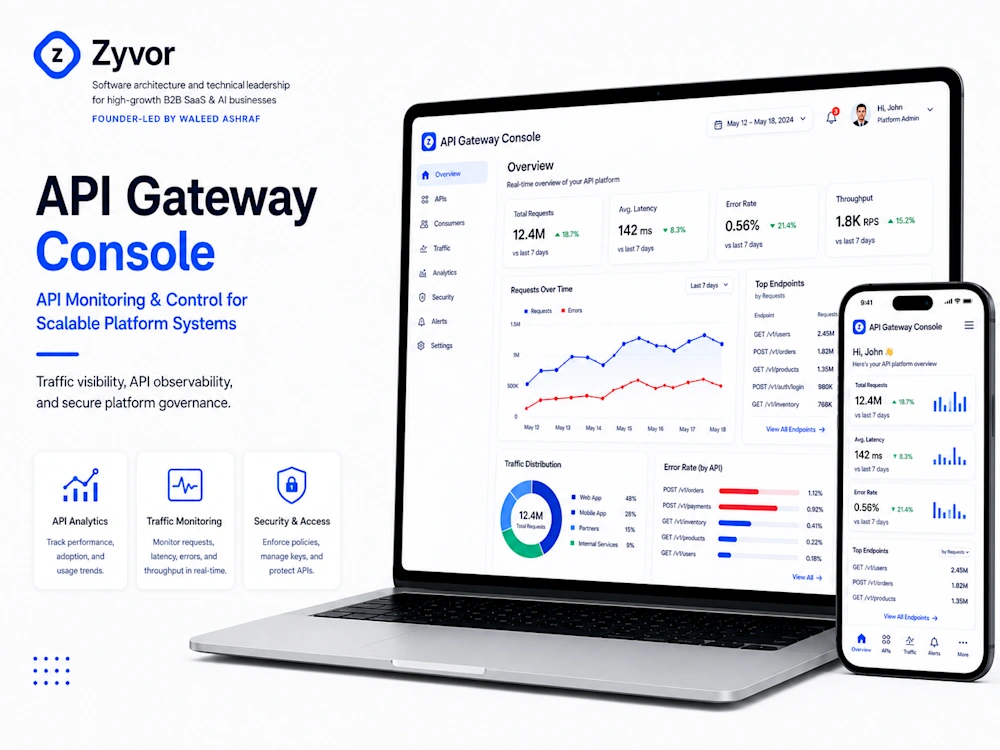
API Gateway Console

Centralized API management platform built with gateway architecture, request validation, rate limiting, access policies, and observability dashboards for scalable service communication.

API Gateway Console project cover
ZyvorMar 1, 2025 – Jun 30, 2025

measurable outcomes

Partner credential management consolidated from 8 systems to 1. Authentication-related support tickets dropped 82%
API abuse incidents dropped to zero. Backend service overload events eliminated. Fair usage enforced across 60+ partners
Malformed requests reaching backends dropped 94%. "API doesn't match docs" tickets dropped from 35% to under 3%
Concrete result: Gateway processing 15K+ requests/second across 60+ partners. Sub-10ms overhead. Zero authentication outages since launch

problem

What had to change.

Authentication was implemented differently across 8 API services. Some used API keys, some used OAuth, some used both. Partners integrating with multiple services needed separate credentials for each
Rate limiting was per-service with no global coordination. A partner could exhaust their rate limit on Service A and still hammer Service B. No aggregate throttling, no partner-level quotas
API documentation was scattered across 4 Notion pages, 2 Swagger files, and a README in a private GitHub repo. 35% of support tickets were "the API doesn't match the documentation"
No request validation at the gateway level. Malformed requests passed through to backend services, causing cryptic 500 errors instead of clear 400 responses
Usage analytics didn't exist. The business team couldn't answer "which partners use which APIs" Pricing decisions were based on guesses
Onboarding a new API partner took 2 weeks of engineering time: credential provisioning, rate limit configuration, documentation walkthrough, and sandbox setup

execution

The implementation lanes behind the project.

One credential set. Every API. Consistent behavior.

Unified Authentication Layer

  • Centralized API key and OAuth 2.0 management with partner-scoped credentials that work across all services
  • Key rotation with grace periods: new keys activate immediately, old keys remain valid for 72 hours preventing integration downtime
  • Scoped access control: partners granted access to specific endpoints, methods, and data scopes
Partner credential management consolidated from 8 systems to 1. Authentication-related support tickets dropped 82%

Partner-level quotas that protect every service simultaneously.

Intelligent Rate Limiting

  • Global rate limiting per partner with configurable quotas across all API services
  • Tiered policies: free partners get 1K requests/hour, standard get 10K, enterprise get custom limits with burst allowances
  • Rate limit headers on every response showing remaining quota and retry-after on 429s
API abuse incidents dropped to zero. Backend service overload events eliminated. Fair usage enforced across 60+ partners

Bad requests caught at the door, not in the basement.

Request Validation and Error Standardization

  • Schema-based request validation at the gateway checking every request against OpenAPI specs before reaching backends
  • Standardized error responses with consistent codes, human-readable messages, and documentation links
  • Request transformation normalizing headers, date formats, and pagination parameters before forwarding
Malformed requests reaching backends dropped 94%. "API doesn't match docs" tickets dropped from 35% to under 3%

Always accurate. Always current. Zero manual maintenance.

Auto-Generated API Documentation

  • Documentation auto-generated from OpenAPI specs with interactive "try it" functionality and code examples in 6 languages
  • Changelog tracking every API change with version history and migration guides
  • Sandbox environment with pre-populated test data for integration testing without affecting production
Documentation accuracy hit 100%. Partner onboarding reduced from 2 weeks to 2 days. Sandbox eliminated 90% of "testing in production" incidents

Know exactly who uses what, how much, and how well.

API Analytics and Partner Intelligence

  • Real-time usage dashboards showing request volume, latency, error rates, and endpoint popularity per partner
  • Partner health scoring based on error rates, retry patterns, and usage trends
  • Business intelligence views: revenue per API, cost per request, and tier optimization recommendations
Usage data revealed 3 APIs generating 80% of partner value. Pricing restructured, API revenue up 26%

Make the implementation usable after launch.

Architecture Handoff and Operating Model

  • Documented the key architecture decisions, tradeoffs, and ownership boundaries behind the work.
  • Connected delivery lanes to support, operations, and future product iteration instead of treating launch as the finish line.
  • Gave the team a clearer operating model for scaling the product without recreating the same bottlenecks.
Gateway processing 15K+ requests/second across 60+ partners. Sub-10ms overhead. Zero authentication outages since launch

project depth

More context behind the API Gateway Console work.

Each selected project is read through business pressure, architecture tradeoffs, delivery sequencing, team operating model, role coverage, and stack fit so the case study stays useful for founders, CTOs, and product leaders evaluating similar work.

business pressure

Why the work mattered

The APIs were the product. The access layer was the bottleneck. The project started from a real operational constraint, not a decorative rebuild, which made the architecture work accountable to business movement.

architecture pressure

Node.js gateway over Kong or AWS API Gateway

Custom rate limiting, request transformation, and validation rules needed more flexibility than off-the-shelf gateways. Custom gateway handles 15K+ requests/second with sub-10ms overhead

implementation priority

Unified Authentication Layer

Partner credential management consolidated from 8 systems to 1. Authentication-related support tickets dropped 82%

operating change

What changed for the team

Partner credential management consolidated from 8 systems to 1. Authentication-related support tickets dropped 82%

role coverage

Leadership and engineering coverage

The work called for software architect, technical lead, backend engineer, api engineer, full-stack engineer coverage, connecting strategy, implementation, and delivery quality instead of treating them as separate tracks.

stack fit

Technology choices in context

Laravel, Node.js, PostgreSQL, Redis, React, TypeScript were part of the delivery context, but the value came from how the stack supported maintainability, scalability, and a stronger path from architecture to production.

architecture decisions

Technical choices that mattered.

Node.js gateway over Kong or AWS API Gateway

Custom rate limiting, request transformation, and validation rules needed more flexibility than off-the-shelf gateways. Custom gateway handles 15K+ requests/second with sub-10ms overhead

Redis for rate limiting and session state

Rate limit counters need atomic increment-and-check on every request. Sliding window counters per partner in sub-1ms. Token bucket algorithm for burst allowances

PostgreSQL for analytics and audit logging

Every request logged with partner ID, endpoint, response code, and latency. Materialized views pre-compute dashboard aggregations. Partitioned by month for historical queries

Docker with horizontal scaling

Stateless gateway containers scale behind a load balancer. Auto-scaling based on request volume handles traffic spikes without manual intervention

operating model

Architecture changes were tied directly to how the software business would operate after launch.

Partner credential management consolidated from 8 systems to 1. Authentication-related support tickets dropped 82%
API abuse incidents dropped to zero. Backend service overload events eliminated. Fair usage enforced across 60+ partners
Gateway processing 15K+ requests/second across 60+ partners. Sub-10ms overhead. Zero authentication outages since launch

results

What changed after the work.

Partner credential management consolidated from 8 systems to 1. Authentication-related support tickets dropped 82%
API abuse incidents dropped to zero. Backend service overload events eliminated. Fair usage enforced across 60+ partners
Malformed requests reaching backends dropped 94%. "API doesn't match docs" tickets dropped from 35% to under 3%

Week 1

Gateway deployed. 60+ partners migrated to unified authentication. Credential management consolidated from 8 systems to 1

Week 3

Rate limiting and request validation live. Malformed requests to backends dropped 94%. API abuse eliminated

Month 1

Auto-generated docs deployed. Partner onboarding from 2 weeks to 2 days. Doc mismatch tickets from 35% to under 3%

Month 2

Analytics revealing usage patterns. Pricing restructured around high-value endpoints, API revenue up 26%

Month 5

Gateway processing 15K+ requests/second across 60+ partners. Sub-10ms overhead. Zero authentication outages since launch

Final outcome

Gateway processing 15K+ requests/second across 60+ partners. Sub-10ms overhead. Zero authentication outages since launch

buyer relevance

Why this project belongs in Zyvor software architecture work.

Software architecture signal

API Gateway Console shows how architecture decisions can move from implementation detail into business leverage for computer software teams.

Technical leadership signal

The work connects software architect, technical lead, backend engineer responsibilities with delivery clarity, execution confidence, and a cleaner operating model.

Scale-readiness signal

Gateway processing 15K+ requests/second across 60+ partners. Sub-10ms overhead. Zero authentication outages since launch

What kind of business is API Gateway Console most relevant for?

This project is most relevant for computer software and computer software teams that need stronger software architecture, clearer technical direction, and more reliable execution as product or operational complexity increases.

What did Zyvor focus on in this selected work?

I built a centralized API gateway and management console that handles authentication, rate limiting, request validation, documentation, analytics, and partner onboarding in a single platform. The work was framed around practical architecture decisions, delivery ownership, and measurable business outcomes rather than advisory language alone.

How does this support Zyvor's software architecture consulting focus?

API Gateway Console supports Zyvor's focus on B2B SaaS and AI software architecture consulting by connecting system design, technical leadership, scalability, and execution quality to a concrete project outcome: Gateway processing 15K+ requests/second across 60+ partners. Sub-10ms overhead. Zero authentication outages since launch

What kind of technical leadership problem does this represent?

It represents the point where delivery pressure, architecture ownership, and business expectations start converging. In work like API Gateway Console, technical leadership is not only about writing code; it is about choosing the right sequence, reducing ambiguity, and giving the team a clearer execution model.

What should a founder or CTO notice in this project?

A founder or CTO should notice the link between the business problem and the technical system underneath it. The most important signal is not a tool choice by itself; it is how the architecture, implementation lanes, and operating model support a measurable business result.

Does this kind of work require a full rebuild?

Not always. The right engagement depends on where the risk sits. Some projects need a focused architecture reset, some need modernization, and some need new product development. Zyvor frames the work around the smallest practical path to stronger scalability, reliability, and delivery confidence.

Decision context

The APIs were the product. The access layer was the bottleneck. That business pressure shaped the architecture choices, implementation order, and operating model behind the work.

Delivery leverage

Partner credential management consolidated from 8 systems to 1. Authentication-related support tickets dropped 82% This is the kind of delivery leverage Zyvor looks for: fewer bottlenecks, clearer ownership, and better execution rhythm.

Architecture handoff

The project covered Laravel, Node.js, PostgreSQL, Redis, React while keeping the handoff focused on maintainability, future change, and leadership clarity instead of isolated implementation tasks.

Best-fit conversation

A similar engagement usually starts with the current bottleneck, the architecture decision that feels stuck, and the business risk that is becoming harder to ignore.