Logistics & Supply Chain selected work

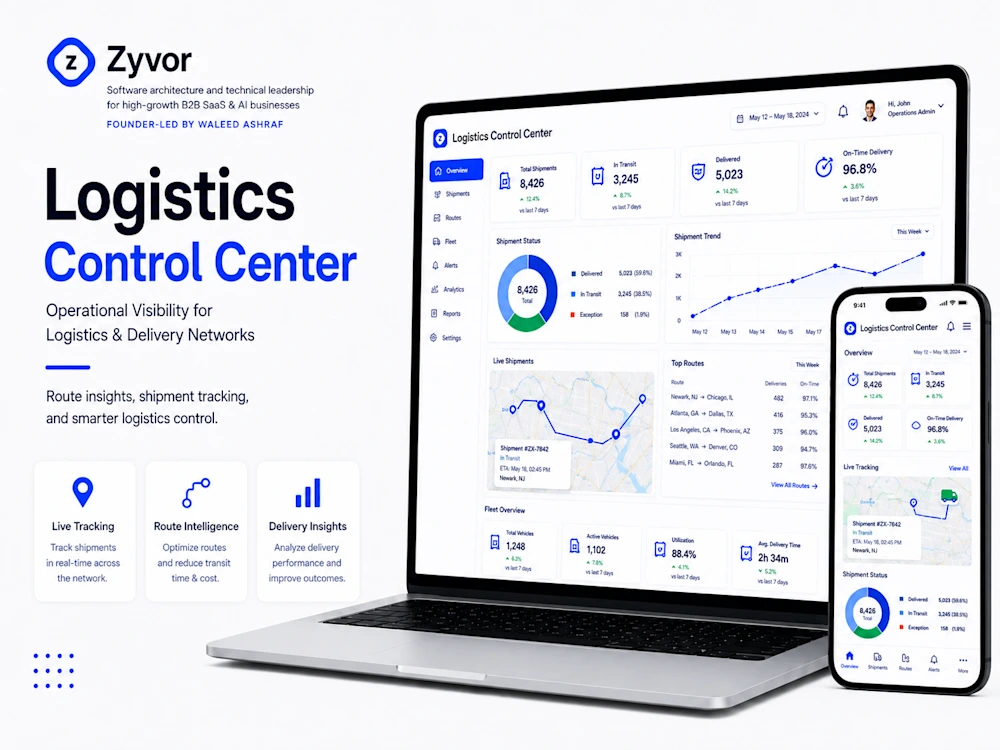
Logistics Control Center

Operations management platform designed for job scheduling, resource allocation, field team coordination, and real-time service tracking across distributed service operations.

Logistics Control Center project cover
MJ Facility ServicesApr 1, 2024 – Aug 31, 2024

measurable outcomes

Double-bookings eliminated. Late arrivals dropped from 35% to under 5%. Scheduling time reduced from 3 hours/day to 45 minutes
"Is someone coming" client calls dropped from 25/day to under 3. Real-time visibility into 100% of active field operations. Client satisfaction scores improved 22%
Illegible/incomplete job sheets dropped from 15% to zero. Documentation compliance hit 100%. Average job sheet completion time reduced from 12 minutes (paper) to 4 minutes (digital)
Concrete result: Platform managing 180+ contracts, 45 technicians, 3 states. Late arrivals under 5%. Zero lost job sheets. Operations coordinator scheduling time from 3 hours/day to 45 minutes

problem

What had to change.

Job scheduling was done by a single operations coordinator using a Google Calendar shared with 45 field technicians. Double-bookings happened 3-4 times per week. Technicians drove to the wrong site at least twice a week because calendar entries lacked address details
Resource allocation was memory-based. The coordinator knew which technicians had which certifications, which tools they carried, and which clients they'd worked with before. When the coordinator was on leave, scheduling quality dropped visibly
No real-time visibility into field operations. The office had no idea whether a technician had arrived at a site, started work, or finished until the technician called in or sent a WhatsApp message. Client calls asking "is someone coming" averaged 25 per day
Service completion documentation was paper-based. Technicians filled out job sheets on-site, photographed them, and WhatsApp'd the photos to the office. 15% of job sheets were illegible, incomplete, or lost entirely
Travel time between jobs wasn't factored into scheduling. Technicians regularly had back-to-back jobs 90 minutes apart with 30-minute gaps scheduled. Late arrivals averaged 35% of all appointments
Invoicing was disconnected from service delivery. The admin team manually created invoices from completed job sheets, often 2-3 weeks after service delivery. Revenue recognition lag averaged 18 days

execution

The implementation lanes behind the project.

The right technician, at the right site, with the right tools, on time.

Intelligent Job Scheduling

  • Constraint-based scheduling engine factoring in technician certifications, tool requirements, client preferences, geographic proximity, and travel time between jobs
  • Drag-and-drop schedule board with conflict detection: double-bookings, certification gaps, and unrealistic travel times flagged before confirmation
  • Recurring job templates for contract-based services (weekly cleaning, monthly inspections, quarterly maintenance) with automatic schedule generation
Double-bookings eliminated. Late arrivals dropped from 35% to under 5%. Scheduling time reduced from 3 hours/day to 45 minutes

Know where every technician is and what they're working on. Right now.

Real-Time Field Tracking

  • Mobile app for field technicians with GPS check-in/check-out, job status updates, and real-time location sharing during active jobs
  • Operations dashboard showing all active jobs on a map with status indicators: en route, on-site, in progress, completed
  • Automated client notifications: "Your technician is en route" and "Service completed" messages sent without office involvement
"Is someone coming" client calls dropped from 25/day to under 3. Real-time visibility into 100% of active field operations. Client satisfaction scores improved 22%

Complete, legible, timestamped job records. Every time.

Digital Service Documentation

  • Mobile-first digital job sheets with structured fields, photo capture, client signature, and GPS-stamped completion records
  • Checklist templates per service type ensuring technicians complete all required steps and document all required evidence
  • Automatic quality validation: incomplete job sheets flagged before the technician can mark the job as complete
Illegible/incomplete job sheets dropped from 15% to zero. Documentation compliance hit 100%. Average job sheet completion time reduced from 12 minutes (paper) to 4 minutes (digital)

Stop scheduling impossible routes.

Travel-Time Optimization

  • Google Maps integration calculating realistic travel times between consecutive jobs, factoring in time of day and traffic patterns
  • Route optimization suggesting job sequence changes that reduce total daily travel time per technician
  • Buffer time rules ensuring minimum gaps between jobs based on service type complexity and expected travel duration
Average daily travel time per technician reduced 28%. Fuel costs down 22%. Late arrivals from travel miscalculation virtually eliminated

Job completed → invoice generated. Same day.

Automated Service-to-Invoice Pipeline

  • Automatic invoice generation triggered on job completion with service details, time on-site, materials used, and applicable contract rates
  • Batch invoicing for contract clients with configurable billing cycles (weekly, fortnightly, monthly) and automatic line item aggregation
  • Integration with Xero for accounting sync, eliminating double-entry and ensuring revenue recognition on completion date
Revenue recognition lag dropped from 18 days to same-day. Manual invoice creation eliminated. Billing accuracy improved to 99.5% through automated rate application

Make the implementation usable after launch.

Architecture Handoff and Operating Model

  • Documented the key architecture decisions, tradeoffs, and ownership boundaries behind the work.
  • Connected delivery lanes to support, operations, and future product iteration instead of treating launch as the finish line.
  • Gave the team a clearer operating model for scaling the product without recreating the same bottlenecks.
Platform managing 180+ contracts, 45 technicians, 3 states. Late arrivals under 5%. Zero lost job sheets. Operations coordinator scheduling time from 3 hours/day to 45 minutes

project depth

More context behind the Logistics Control Center work.

Each selected project is read through business pressure, architecture tradeoffs, delivery sequencing, team operating model, role coverage, and stack fit so the case study stays useful for founders, CTOs, and product leaders evaluating similar work.

business pressure

Why the work mattered

The company was growing its contract base faster than its ability to coordinate the work. Every new contract made the scheduling problem exponentially harder. The project started from a real operational constraint, not a decorative rebuild, which made the architecture work accountable to business movement.

architecture pressure

PostgreSQL with PostGIS for geographic queries

Scheduling optimization requires geographic proximity calculations across 180+ service locations and 45 technician positions. PostGIS handles distance calculations, nearest-neighbor queries, and route clustering natively in the database

implementation priority

Intelligent Job Scheduling

Double-bookings eliminated. Late arrivals dropped from 35% to under 5%. Scheduling time reduced from 3 hours/day to 45 minutes

operating change

What changed for the team

Double-bookings eliminated. Late arrivals dropped from 35% to under 5%. Scheduling time reduced from 3 hours/day to 45 minutes

role coverage

Leadership and engineering coverage

The work called for software architect, technical lead, backend engineer, api engineer, full-stack engineer coverage, connecting strategy, implementation, and delivery quality instead of treating them as separate tracks.

stack fit

Technology choices in context

AWS, Next.js, Node.js, PostgreSQL, React, TypeScript were part of the delivery context, but the value came from how the stack supported maintainability, scalability, and a stronger path from architecture to production.

architecture decisions

Technical choices that mattered.

PostgreSQL with PostGIS for geographic queries

Scheduling optimization requires geographic proximity calculations across 180+ service locations and 45 technician positions. PostGIS handles distance calculations, nearest-neighbor queries, and route clustering natively in the database

TypeScript with strict mode for scheduling logic

Scheduling constraint logic is complex: certification requirements, time windows, travel buffers, recurring patterns. TypeScript's type system catches constraint violations at compile time. Strict mode prevents the subtle null/undefined bugs that cause silent scheduling errors

AWS Lambda for invoice generation

Invoice generation is bursty: batch invoicing at month-end generates 180+ invoices in minutes, then nothing for days. Lambda scales to handle the burst without paying for idle compute between billing cycles

Next.js PWA for field technician mobile app

Field technicians work in areas with spotty mobile coverage (basements, rural properties). PWA with service worker caching allows job sheet completion offline with automatic sync when connectivity returns

operating model

Architecture changes were tied directly to how the software business would operate after launch.

Double-bookings eliminated. Late arrivals dropped from 35% to under 5%. Scheduling time reduced from 3 hours/day to 45 minutes
"Is someone coming" client calls dropped from 25/day to under 3. Real-time visibility into 100% of active field operations. Client satisfaction scores improved 22%
Platform managing 180+ contracts, 45 technicians, 3 states. Late arrivals under 5%. Zero lost job sheets. Operations coordinator scheduling time from 3 hours/day to 45 minutes

results

What changed after the work.

Double-bookings eliminated. Late arrivals dropped from 35% to under 5%. Scheduling time reduced from 3 hours/day to 45 minutes
"Is someone coming" client calls dropped from 25/day to under 3. Real-time visibility into 100% of active field operations. Client satisfaction scores improved 22%
Illegible/incomplete job sheets dropped from 15% to zero. Documentation compliance hit 100%. Average job sheet completion time reduced from 12 minutes (paper) to 4 minutes (digital)

Week 1

Scheduling engine deployed. Double-bookings eliminated immediately. Travel-time calculations preventing impossible routes

Week 3

Field tracking live. "Is someone coming" calls dropped from 25/day to 8. Digital job sheets replacing paper forms

Month 1

Late arrivals from 35% to under 10%. Job sheet compliance at 100%. Automated invoicing generating same-day invoices on job completion

Month 2

Travel time optimization reducing fuel costs 22%. Revenue recognition lag from 18 days to same-day. Client satisfaction scores up 22%

Month 5

Platform managing 180+ contracts, 45 technicians, 3 states. Late arrivals under 5%. Zero lost job sheets. Operations coordinator scheduling time from 3 hours/day to 45 minutes

Final outcome

Platform managing 180+ contracts, 45 technicians, 3 states. Late arrivals under 5%. Zero lost job sheets. Operations coordinator scheduling time from 3 hours/day to 45 minutes

buyer relevance

Why this project belongs in Zyvor software architecture work.

Software architecture signal

Logistics Control Center shows how architecture decisions can move from implementation detail into business leverage for logistics & supply chain teams.

Technical leadership signal

The work connects software architect, technical lead, backend engineer responsibilities with delivery clarity, execution confidence, and a cleaner operating model.

Scale-readiness signal

Platform managing 180+ contracts, 45 technicians, 3 states. Late arrivals under 5%. Zero lost job sheets. Operations coordinator scheduling time from 3 hours/day to 45 minutes

What kind of business is Logistics Control Center most relevant for?

This project is most relevant for logistics & supply chain and logistics & supply chain teams that need stronger software architecture, clearer technical direction, and more reliable execution as product or operational complexity increases.

What did Zyvor focus on in this selected work?

I built an operations management platform that handles job scheduling with travel-time awareness, real-time field tracking, digital service documentation, and automated invoicing. Designed so the operations team manages exceptions, not every routine job. The work was framed around practical architecture decisions, delivery ownership, and measurable business outcomes rather than advisory language alone.

How does this support Zyvor's software architecture consulting focus?

Logistics Control Center supports Zyvor's focus on B2B SaaS and AI software architecture consulting by connecting system design, technical leadership, scalability, and execution quality to a concrete project outcome: Platform managing 180+ contracts, 45 technicians, 3 states. Late arrivals under 5%. Zero lost job sheets. Operations coordinator scheduling time from 3 hours/day to 45 minutes

What kind of technical leadership problem does this represent?

It represents the point where delivery pressure, architecture ownership, and business expectations start converging. In work like Logistics Control Center, technical leadership is not only about writing code; it is about choosing the right sequence, reducing ambiguity, and giving the team a clearer execution model.

What should a founder or CTO notice in this project?

A founder or CTO should notice the link between the business problem and the technical system underneath it. The most important signal is not a tool choice by itself; it is how the architecture, implementation lanes, and operating model support a measurable business result.

Does this kind of work require a full rebuild?

Not always. The right engagement depends on where the risk sits. Some projects need a focused architecture reset, some need modernization, and some need new product development. Zyvor frames the work around the smallest practical path to stronger scalability, reliability, and delivery confidence.

Decision context

The company was growing its contract base faster than its ability to coordinate the work. Every new contract made the scheduling problem exponentially harder. That business pressure shaped the architecture choices, implementation order, and operating model behind the work.

Delivery leverage

Double-bookings eliminated. Late arrivals dropped from 35% to under 5%. Scheduling time reduced from 3 hours/day to 45 minutes This is the kind of delivery leverage Zyvor looks for: fewer bottlenecks, clearer ownership, and better execution rhythm.

Architecture handoff

The project covered AWS, Next.js, Node.js, PostgreSQL, React while keeping the handoff focused on maintainability, future change, and leadership clarity instead of isolated implementation tasks.

Best-fit conversation

A similar engagement usually starts with the current bottleneck, the architecture decision that feels stuck, and the business risk that is becoming harder to ignore.