Education selected work

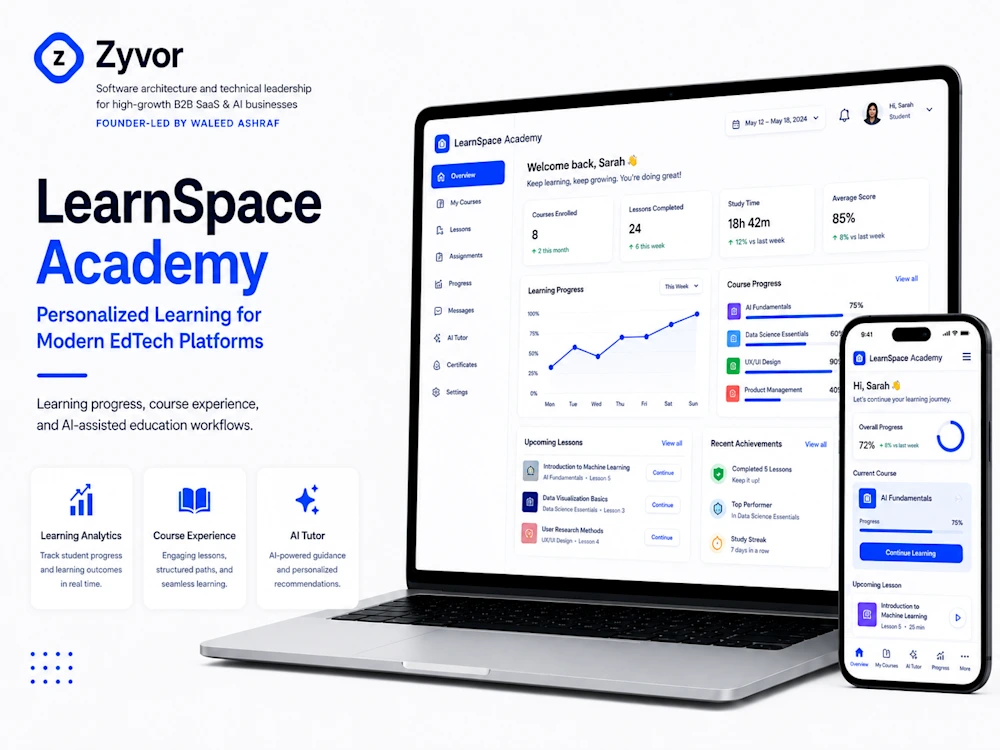
LearnSpace Academy

EdTech platform designed for course management, learner progress tracking, assessment workflows, content delivery, and instructor collaboration across structured learning programs.

LearnSpace Academy project cover
ZyvorMay 1, 2025 – Jun 30, 2025

measurable outcomes

Course creation time reduced 60%. Content version conflicts eliminated. 45+ programs consolidated from 3 platforms into 1
Program completion rates improved from 62% to 84%. At-risk learner identification 3 weeks earlier than manual detection. Certificate generation from 2 hours manual work to instant
Grading turnaround dropped from 5 business days to same-day for auto-graded and 48 hours for manual. Assessment quality improved through data-driven question refinement
Concrete result: Platform serving 45+ programs, 3,000+ active learners, 15 corporate clients. Content redesigns from analytics data improving completion by 15%. Corporate client retention up 28%

problem

What had to change.

Course content lived in 3 different platforms with no unified catalog. Instructors uploaded materials to whichever tool they preferred. Finding the latest version of a module required asking the instructor directly
Learner progress tracking was per-platform. A learner enrolled in 2 programs had 2 separate dashboards with no cross-program view. Completion certificates were generated manually in Canva
Assessment workflows were entirely manual. Instructors created quizzes in Google Forms, graded them in spreadsheets, and emailed results to learners. Average grading turnaround: 5 business days
Corporate clients purchasing bulk enrollments had no visibility into their employees' progress. Monthly progress reports were compiled manually by an admin, taking 2 days per client
Content versioning didn't exist. When an instructor updated a module, learners mid-course sometimes saw the old version and sometimes the new one, depending on caching. No rollback capability
The company couldn't answer basic questions: What's the average completion rate Which modules have the highest drop-off Where do learners struggle most No analytics, no data, no insight

execution

The implementation lanes behind the project.

One platform. Every program. Every instructor.

Unified Course Management

  • Structured course builder with module sequencing, prerequisite chains, and content type support (video, documents, interactive exercises, live sessions)
  • Multi-instructor collaboration with role-based editing, review workflows, and version history on every content change
  • Content versioning with learner-cohort pinning: learners see the version they started with, new cohorts get the latest version. Instructors can push critical updates to all active cohorts
Course creation time reduced 60%. Content version conflicts eliminated. 45+ programs consolidated from 3 platforms into 1

See exactly where every learner is, across every program.

Adaptive Learner Progress Tracking

  • Cross-program learner dashboard showing enrollment status, completion percentage, upcoming deadlines, and assessment scores in a single view
  • Adaptive pacing recommendations based on learner engagement patterns: flagging learners falling behind before they disengage
  • Automated completion certificates generated on program finish with verifiable credentials and shareable links
Program completion rates improved from 62% to 84%. At-risk learner identification 3 weeks earlier than manual detection. Certificate generation from 2 hours manual work to instant

Create, deliver, grade, and analyze assessments without leaving the platform.

Assessment Engine

  • Assessment builder supporting multiple question types (multiple choice, short answer, essay, file upload, peer review) with configurable grading rubrics
  • Auto-grading for objective questions with instant results. Manual grading queue for subjective assessments with rubric-guided scoring and inline feedback
  • Assessment analytics showing question-level difficulty, discrimination index, and common wrong answers to help instructors improve their assessments
Grading turnaround dropped from 5 business days to same-day for auto-graded and 48 hours for manual. Assessment quality improved through data-driven question refinement

Bulk enrollment clients see their team's progress in real time.

Corporate Client Portal

  • White-labeled client dashboard showing enrolled employees, progress by program, completion rates, and assessment scores
  • Bulk enrollment management with CSV upload, automatic account provisioning, and program assignment
  • Automated progress reports delivered weekly to client stakeholders with configurable metrics and thresholds
Manual report generation eliminated (was 2 days per client per month). Corporate client retention improved 28% through transparency. Bulk onboarding from 1 week to 15 minutes

Finally answer: where do learners struggle, and why

Learning Analytics Dashboard

  • Program-level analytics showing enrollment trends, completion funnels, module-by-module drop-off rates, and time-to-completion distributions
  • Module engagement heatmaps showing which content sections learners spend the most time on, skip, or revisit
  • Instructor performance metrics: average grading time, feedback quality scores, and learner satisfaction ratings
Drop-off hotspots identified in 12 programs, leading to content redesigns that improved completion by 15%. Data-driven curriculum decisions replacing instructor intuition

Make the implementation usable after launch.

Architecture Handoff and Operating Model

  • Documented the key architecture decisions, tradeoffs, and ownership boundaries behind the work.
  • Connected delivery lanes to support, operations, and future product iteration instead of treating launch as the finish line.
  • Gave the team a clearer operating model for scaling the product without recreating the same bottlenecks.
Platform serving 45+ programs, 3,000+ active learners, 15 corporate clients. Content redesigns from analytics data improving completion by 15%. Corporate client retention up 28%

project depth

More context behind the LearnSpace Academy work.

Each selected project is read through business pressure, architecture tradeoffs, delivery sequencing, team operating model, role coverage, and stack fit so the case study stays useful for founders, CTOs, and product leaders evaluating similar work.

business pressure

Why the work mattered

The education company was selling structured learning but delivering it through unstructured tools. The project started from a real operational constraint, not a decorative rebuild, which made the architecture work accountable to business movement.

architecture pressure

PostgreSQL with JSONB for flexible content schemas

Course content varies wildly: video modules, document libraries, interactive exercises, live session schedules. JSONB columns store module-specific metadata while relational tables handle the structured learning path, progress tracking, and assessment data

implementation priority

Unified Course Management

Course creation time reduced 60%. Content version conflicts eliminated. 45+ programs consolidated from 3 platforms into 1

operating change

What changed for the team

Course creation time reduced 60%. Content version conflicts eliminated. 45+ programs consolidated from 3 platforms into 1

role coverage

Leadership and engineering coverage

The work called for software architect, technical lead, full-stack engineer, backend engineer, api engineer coverage, connecting strategy, implementation, and delivery quality instead of treating them as separate tracks.

stack fit

Technology choices in context

Laravel, Next.js, PostgreSQL, AWS, React, Node.js were part of the delivery context, but the value came from how the stack supported maintainability, scalability, and a stronger path from architecture to production.

architecture decisions

Technical choices that mattered.

PostgreSQL with JSONB for flexible content schemas

Course content varies wildly: video modules, document libraries, interactive exercises, live session schedules. JSONB columns store module-specific metadata while relational tables handle the structured learning path, progress tracking, and assessment data

AWS S3 with CloudFront for content delivery

Video and document content needs fast, reliable delivery across geographies. CloudFront edge caching serves content from the nearest location. Signed URLs ensure only enrolled learners access premium content

Laravel for assessment engine and grading workflows

Complex grading rubrics, peer review assignments, and multi-stage assessment pipelines need robust queue processing. Laravel's job system handles async grading, notification delivery, and report generation without blocking the main application

Next.js with ISR for course catalog pages

Course catalog pages are high-traffic, low-change content. Incremental Static Regeneration serves pre-built pages with sub-second loads while revalidating when instructors publish updates

operating model

Architecture changes were tied directly to how the software business would operate after launch.

Course creation time reduced 60%. Content version conflicts eliminated. 45+ programs consolidated from 3 platforms into 1
Program completion rates improved from 62% to 84%. At-risk learner identification 3 weeks earlier than manual detection. Certificate generation from 2 hours manual work to instant
Platform serving 45+ programs, 3,000+ active learners, 15 corporate clients. Content redesigns from analytics data improving completion by 15%. Corporate client retention up 28%

results

What changed after the work.

Course creation time reduced 60%. Content version conflicts eliminated. 45+ programs consolidated from 3 platforms into 1
Program completion rates improved from 62% to 84%. At-risk learner identification 3 weeks earlier than manual detection. Certificate generation from 2 hours manual work to instant
Grading turnaround dropped from 5 business days to same-day for auto-graded and 48 hours for manual. Assessment quality improved through data-driven question refinement

Week 1

Course catalog consolidated from 3 platforms. 45+ programs migrated with content versioning. Instructor collaboration tools live

Week 3

Assessment engine deployed. Auto-grading live for objective assessments. Grading turnaround from 5 days to same-day

Month 1

Corporate client portal launched. Manual reporting eliminated. Bulk enrollment from 1 week to 15 minutes. Learner progress tracking cross-program

Month 2

Completion rates climbing from 62% toward 84%. At-risk learner detection flagging disengagement 3 weeks earlier. Analytics identifying 12 drop-off hotspots

Month 4

Platform serving 45+ programs, 3,000+ active learners, 15 corporate clients. Content redesigns from analytics data improving completion by 15%. Corporate client retention up 28%

Final outcome

Platform serving 45+ programs, 3,000+ active learners, 15 corporate clients. Content redesigns from analytics data improving completion by 15%. Corporate client retention up 28%

buyer relevance

Why this project belongs in Zyvor software architecture work.

Software architecture signal

LearnSpace Academy shows how architecture decisions can move from implementation detail into business leverage for education teams.

Technical leadership signal

The work connects software architect, technical lead, full-stack engineer responsibilities with delivery clarity, execution confidence, and a cleaner operating model.

Scale-readiness signal

Platform serving 45+ programs, 3,000+ active learners, 15 corporate clients. Content redesigns from analytics data improving completion by 15%. Corporate client retention up 28%

What kind of business is LearnSpace Academy most relevant for?

This project is most relevant for education and education teams that need stronger software architecture, clearer technical direction, and more reliable execution as product or operational complexity increases.

What did Zyvor focus on in this selected work?

I built a unified learning management platform that handles course creation, content delivery, assessment workflows, learner progress tracking, and corporate client reporting in a single system. Designed for instructors who teach, not instructors who troubleshoot software. The work was framed around practical architecture decisions, delivery ownership, and measurable business outcomes rather than advisory language alone.

How does this support Zyvor's software architecture consulting focus?

LearnSpace Academy supports Zyvor's focus on B2B SaaS and AI software architecture consulting by connecting system design, technical leadership, scalability, and execution quality to a concrete project outcome: Platform serving 45+ programs, 3,000+ active learners, 15 corporate clients. Content redesigns from analytics data improving completion by 15%. Corporate client retention up 28%

What kind of technical leadership problem does this represent?

It represents the point where delivery pressure, architecture ownership, and business expectations start converging. In work like LearnSpace Academy, technical leadership is not only about writing code; it is about choosing the right sequence, reducing ambiguity, and giving the team a clearer execution model.

What should a founder or CTO notice in this project?

A founder or CTO should notice the link between the business problem and the technical system underneath it. The most important signal is not a tool choice by itself; it is how the architecture, implementation lanes, and operating model support a measurable business result.

Does this kind of work require a full rebuild?

Not always. The right engagement depends on where the risk sits. Some projects need a focused architecture reset, some need modernization, and some need new product development. Zyvor frames the work around the smallest practical path to stronger scalability, reliability, and delivery confidence.

Decision context

The education company was selling structured learning but delivering it through unstructured tools. That business pressure shaped the architecture choices, implementation order, and operating model behind the work.

Delivery leverage

Course creation time reduced 60%. Content version conflicts eliminated. 45+ programs consolidated from 3 platforms into 1 This is the kind of delivery leverage Zyvor looks for: fewer bottlenecks, clearer ownership, and better execution rhythm.

Architecture handoff

The project covered Laravel, Next.js, PostgreSQL, AWS, React while keeping the handoff focused on maintainability, future change, and leadership clarity instead of isolated implementation tasks.

Best-fit conversation

A similar engagement usually starts with the current bottleneck, the architecture decision that feels stuck, and the business risk that is becoming harder to ignore.