Education selected work

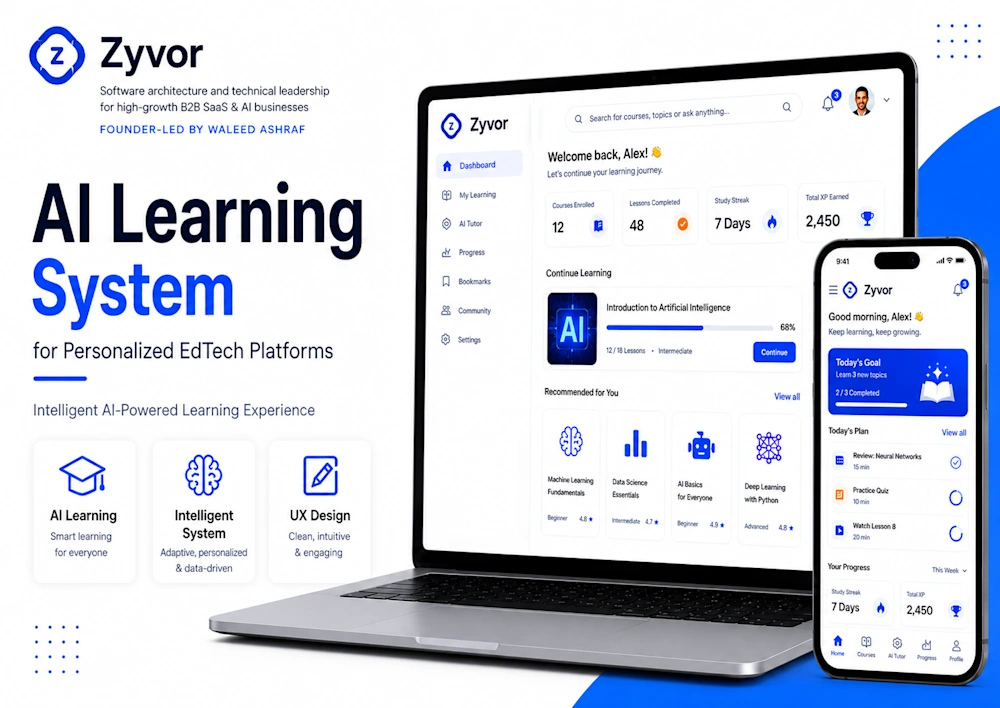
AI Learning System

AI-powered learning platform designed for adaptive course delivery, intelligent tutoring, progress tracking, and personalized recommendations across structured education programs.

AI Learning System project cover
ZyvorApr 1, 2023 – Aug 31, 2023

measurable outcomes

Average course completion time reduced 35% (learners skip what they already know). Learner satisfaction scores improved from 3.2/5 to 4.4/5. Course completion rates climbing from 48% toward 72%
85% of learner questions resolved by AI tutor without instructor involvement. Average response time from 12-48 hours to under 10 seconds. Instructor question-answering workload reduced 80%
Cross-course enrollment increased 45% through personalized recommendations. Learners following AI-recommended paths showed 28% higher completion rates than self-selected paths
Concrete result: Completion rates at 72%. Knowledge retention at 30 days from 35% to 68%. Cross-course enrollment up 45%. Instructor workload reduced 80% on question answering. Platform serving 5,000+ learners with AI-personalized experiences

problem

What had to change.

One-size-fits-all content delivery. A beginner and an intermediate learner in the same course saw identical modules in identical order. Beginners struggled with advanced concepts introduced too early. Intermediate learners sat through basics they already knew
No adaptive assessment. Quizzes tested what was taught, not what was learned. A learner who already knew 60% of the material still had to complete 100% of the content before progressing. No mechanism to skip mastered topics
Learner support was instructor-dependent. When a learner got stuck, they posted in a forum and waited 12-48 hours for an instructor response. 40% of stuck learners abandoned the course before getting help
Content recommendations were nonexistent. After completing a course, learners had no guidance on what to take next. Cross-course pathways were invisible, and learners who would benefit from prerequisite courses discovered this only after struggling
Instructor workload was unsustainable. Each instructor managed 200+ active learners, spending 3+ hours daily answering repetitive questions ("What does this term mean", "Can you explain this concept differently", "What should I study next")
Learning outcome measurement was limited to quiz scores. No insight into concept mastery, knowledge retention over time, or skill application. A learner could pass a quiz through memorization and still lack practical understanding

execution

The implementation lanes behind the project.

Every learner gets the right content at the right time.

Adaptive Content Delivery

  • Diagnostic assessment at course start evaluating existing knowledge across all course topics, creating a personalized learning map that skips mastered content and focuses on gaps
  • Dynamic difficulty adjustment: content complexity adapts based on assessment performance, time-on-task, and hint usage. Struggling learners get additional explanations and examples. Advanced learners get challenge problems
  • Prerequisite detection: when a learner struggles with a concept, the system identifies which prerequisite knowledge is missing and inserts targeted review modules
Average course completion time reduced 35% (learners skip what they already know). Learner satisfaction scores improved from 3.2/5 to 4.4/5. Course completion rates climbing from 48% toward 72%

Stuck Get help in 10 seconds, not 12 hours.

AI Tutoring Assistant

  • Context-aware AI tutor that understands where the learner is in the course, what they've struggled with, and what they've mastered. Answers questions with explanations tailored to the learner's demonstrated level
  • Socratic method mode: instead of giving direct answers, the AI asks guiding questions that lead the learner to discover the answer themselves
  • Escalation to human instructor when the AI detects the learner needs deeper support (repeated questions on the same topic, frustration signals, explicit escalation request)
85% of learner questions resolved by AI tutor without instructor involvement. Average response time from 12-48 hours to under 10 seconds. Instructor question-answering workload reduced 80%

What should I learn next The system knows.

Personalized Learning Paths

  • AI-generated learning path recommendations based on completed courses, demonstrated strengths, career goals, and peer learning patterns
  • Skill gap analysis showing the learner which skills they've developed, which are in progress, and which are needed for their stated goals
  • Cross-course prerequisite mapping: the system recommends foundational courses before advanced ones, preventing the "I'm lost because I skipped the basics" problem
Cross-course enrollment increased 45% through personalized recommendations. Learners following AI-recommended paths showed 28% higher completion rates than self-selected paths

Measure understanding, not just quiz scores.

Concept Mastery Tracking

  • Knowledge graph per learner mapping concept mastery across all enrolled courses with confidence scores based on assessment performance, application exercises, and spaced repetition results
  • Spaced repetition engine: previously mastered concepts resurface at optimal intervals to ensure long-term retention, not just short-term memorization
  • Mastery-based progression: learners advance when they demonstrate concept mastery, not when they complete a time-based module
Knowledge retention at 30 days improved from 35% to 68% through spaced repetition. Mastery-based progression ensuring learners actually understand material before advancing

See where learners struggle before they tell you.

Instructor Intelligence Dashboard

  • Cohort-level analytics showing which concepts have the lowest mastery rates, which modules have the highest drop-off, and which questions generate the most AI tutor interactions
  • Individual learner profiles with learning velocity, struggle points, AI tutor interaction history, and predicted completion timeline
  • Content effectiveness scoring: each module rated by learner outcomes, enabling data-driven content improvement
Instructors identifying content issues through data instead of waiting for complaints. 12 modules redesigned based on mastery data, improving pass rates 25%. Instructor time shifted from answering questions to improving curriculum

Make the implementation usable after launch.

Architecture Handoff and Operating Model

  • Documented the key architecture decisions, tradeoffs, and ownership boundaries behind the work.
  • Connected delivery lanes to support, operations, and future product iteration instead of treating launch as the finish line.
  • Gave the team a clearer operating model for scaling the product without recreating the same bottlenecks.
Completion rates at 72%. Knowledge retention at 30 days from 35% to 68%. Cross-course enrollment up 45%. Instructor workload reduced 80% on question answering. Platform serving 5,000+ learners with AI-personalized experiences

project depth

More context behind the AI Learning System work.

Each selected project is read through business pressure, architecture tradeoffs, delivery sequencing, team operating model, role coverage, and stack fit so the case study stays useful for founders, CTOs, and product leaders evaluating similar work.

business pressure

Why the work mattered

The platform was teaching at learners, not adapting to them. And it was burning out instructors in the process. The project started from a real operational constraint, not a decorative rebuild, which made the architecture work accountable to business movement.

architecture pressure

OpenAI with RAG for the AI tutor

Course content changes frequently as instructors update materials. RAG with course content as context means the AI tutor's knowledge updates immediately when content changes. No model retraining needed. Guardrails prevent the AI from answering questions outside the course scope

implementation priority

Adaptive Content Delivery

Average course completion time reduced 35% (learners skip what they already know). Learner satisfaction scores improved from 3.2/5 to 4.4/5. Course completion rates climbing from 48% toward 72%
operating change

What changed for the team

Average course completion time reduced 35% (learners skip what they already know). Learner satisfaction scores improved from 3.2/5 to 4.4/5. Course completion rates climbing from 48% toward 72%

role coverage

Leadership and engineering coverage

The work called for software architect, technical lead, ai engineer, full-stack engineer, backend engineer coverage, connecting strategy, implementation, and delivery quality instead of treating them as separate tracks.

stack fit

Technology choices in context

OpenAI, Next.js, Node.js, PostgreSQL, React, TypeScript were part of the delivery context, but the value came from how the stack supported maintainability, scalability, and a stronger path from architecture to production.

architecture decisions

Technical choices that mattered.

OpenAI with RAG for the AI tutor

Course content changes frequently as instructors update materials. RAG with course content as context means the AI tutor's knowledge updates immediately when content changes. No model retraining needed. Guardrails prevent the AI from answering questions outside the course scope

PostgreSQL with JSONB for learner knowledge graphs

Each learner's knowledge graph has a different shape depending on their courses and progress. JSONB stores the graph structure while relational tables handle the fixed-schema data (enrollments, assessments, progress). Graph queries for prerequisite detection run in under 50ms

AWS SQS for spaced repetition scheduling

Spaced repetition requires delivering review prompts at specific future times per learner. SQS delay queues schedule review notifications with per-learner timing. 5,000+ learners with different review schedules processed without a custom scheduler

Next.js with streaming for AI tutor responses

AI tutor responses need to feel conversational, not like waiting for a page load. Server-sent events stream the AI response token by token, giving learners immediate feedback while the full response generates

operating model

Architecture changes were tied directly to how the software business would operate after launch.

Average course completion time reduced 35% (learners skip what they already know). Learner satisfaction scores improved from 3.2/5 to 4.4/5. Course completion rates climbing from 48% toward 72%
85% of learner questions resolved by AI tutor without instructor involvement. Average response time from 12-48 hours to under 10 seconds. Instructor question-answering workload reduced 80%
Completion rates at 72%. Knowledge retention at 30 days from 35% to 68%. Cross-course enrollment up 45%. Instructor workload reduced 80% on question answering. Platform serving 5,000+ learners with AI-personalized experiences

results

What changed after the work.

Average course completion time reduced 35% (learners skip what they already know). Learner satisfaction scores improved from 3.2/5 to 4.4/5. Course completion rates climbing from 48% toward 72%
85% of learner questions resolved by AI tutor without instructor involvement. Average response time from 12-48 hours to under 10 seconds. Instructor question-answering workload reduced 80%
Cross-course enrollment increased 45% through personalized recommendations. Learners following AI-recommended paths showed 28% higher completion rates than self-selected paths

Week 1

Adaptive content delivery live. Diagnostic assessments personalizing learning paths for new enrollments. Average course time starting to decrease as learners skip mastered content

Week 3

AI tutor deployed. 85% of learner questions resolved without instructor involvement. Response time from 12-48 hours to under 10 seconds

Month 1

Personalized learning paths generating cross-course recommendations. Spaced repetition engine active. Instructor dashboard showing concept mastery data across cohorts

Month 2

Course completion rates climbing from 48% toward 65%. Learner satisfaction from 3.2/5 to 4.1/5. 12 modules identified for redesign through mastery data

Month 5

Completion rates at 72%. Knowledge retention at 30 days from 35% to 68%. Cross-course enrollment up 45%. Instructor workload reduced 80% on question answering. Platform serving 5,000+ learners with AI-personalized experiences

Final outcome

Completion rates at 72%. Knowledge retention at 30 days from 35% to 68%. Cross-course enrollment up 45%. Instructor workload reduced 80% on question answering. Platform serving 5,000+ learners with AI-personalized experiences

buyer relevance

Why this project belongs in Zyvor software architecture work.

Software architecture signal

AI Learning System shows how architecture decisions can move from implementation detail into business leverage for education teams.

Technical leadership signal

The work connects software architect, technical lead, ai engineer responsibilities with delivery clarity, execution confidence, and a cleaner operating model.

Scale-readiness signal

Completion rates at 72%. Knowledge retention at 30 days from 35% to 68%. Cross-course enrollment up 45%. Instructor workload reduced 80% on question answering. Platform serving 5,000+ learners with AI-personalized experiences

What kind of business is AI Learning System most relevant for?

This project is most relevant for education and education teams that need stronger software architecture, clearer technical direction, and more reliable execution as product or operational complexity increases.

What did Zyvor focus on in this selected work?

I built an AI-powered learning platform that adapts content delivery to each learner's level, provides instant AI tutoring for stuck moments, recommends personalized learning paths, and gives instructors data-driven insights into learner progress. Designed to make every learner feel like they have a private tutor. The work was framed around practical architecture decisions, delivery ownership, and measurable business outcomes rather than advisory language alone.

How does this support Zyvor's software architecture consulting focus?

AI Learning System supports Zyvor's focus on B2B SaaS and AI software architecture consulting by connecting system design, technical leadership, scalability, and execution quality to a concrete project outcome: Completion rates at 72%. Knowledge retention at 30 days from 35% to 68%. Cross-course enrollment up 45%. Instructor workload reduced 80% on question answering. Platform serving 5,000+ learners with AI-personalized experiences

What kind of technical leadership problem does this represent?

It represents the point where delivery pressure, architecture ownership, and business expectations start converging. In work like AI Learning System, technical leadership is not only about writing code; it is about choosing the right sequence, reducing ambiguity, and giving the team a clearer execution model.

What should a founder or CTO notice in this project?

A founder or CTO should notice the link between the business problem and the technical system underneath it. The most important signal is not a tool choice by itself; it is how the architecture, implementation lanes, and operating model support a measurable business result.

Does this kind of work require a full rebuild?

Not always. The right engagement depends on where the risk sits. Some projects need a focused architecture reset, some need modernization, and some need new product development. Zyvor frames the work around the smallest practical path to stronger scalability, reliability, and delivery confidence.

Decision context

The platform was teaching at learners, not adapting to them. And it was burning out instructors in the process. That business pressure shaped the architecture choices, implementation order, and operating model behind the work.

Delivery leverage

Average course completion time reduced 35% (learners skip what they already know). Learner satisfaction scores improved from 3.2/5 to 4.4/5. Course completion rates climbing from 48% toward 72% This is the kind of delivery leverage Zyvor looks for: fewer bottlenecks, clearer ownership, and better execution rhythm.

Architecture handoff

The project covered OpenAI, Next.js, Node.js, PostgreSQL, React while keeping the handoff focused on maintainability, future change, and leadership clarity instead of isolated implementation tasks.

Best-fit conversation

A similar engagement usually starts with the current bottleneck, the architecture decision that feels stuck, and the business risk that is becoming harder to ignore.