Retail selected work

eCommerce Marketplace

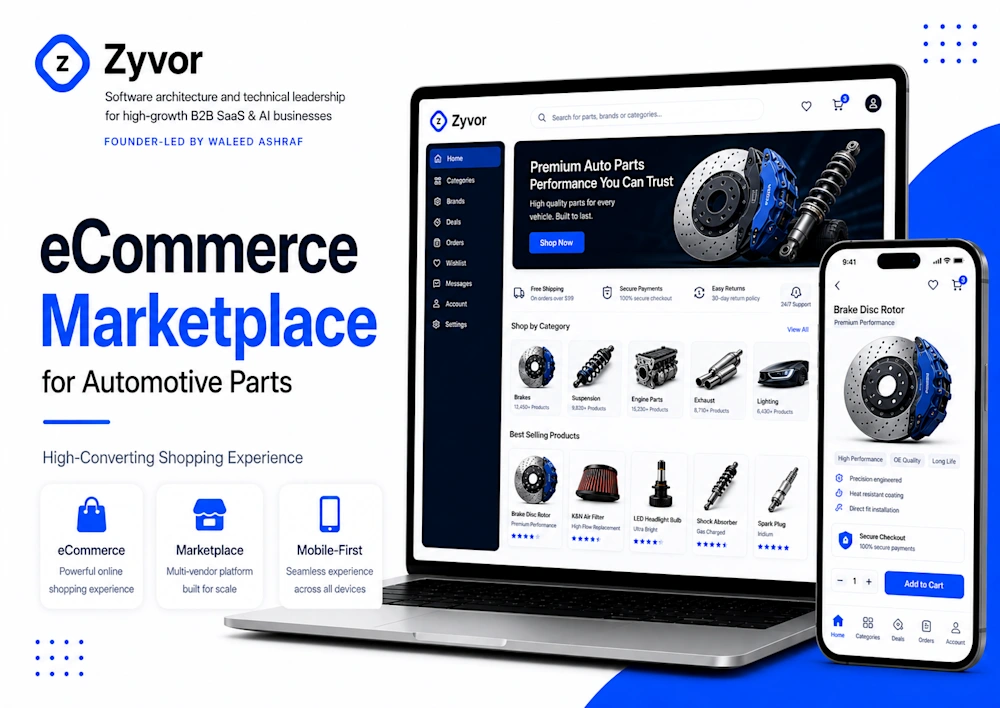
Multi-vendor eCommerce marketplace designed for product browsing, cart management, wishlist functionality, checkout optimization, and mobile-first shopping experiences across high-volume retail.

eCommerce Marketplace project cover
LXR PerfumesDec 1, 2021 – Mar 31, 2022

measurable outcomes

Page load time dropped from 6.2 seconds to 1.4 seconds on desktop and from 9+ seconds to 1.8 seconds on mobile. Bounce rate reduced 38%. Time on site increased 52%
Checkout abandonment dropped from 72% to 31%. Mobile checkout completion rate improved 3.4x. Average time from cart to confirmation: 47 seconds
Mobile conversion rate improved from 0.8% to 2.6% (3.25x increase). Mobile revenue share grew from 38% to 58% of total. Mobile bounce rate dropped 44%
Concrete result: Platform handling 200+ orders/day during peak with sub-2-second loads. Checkout abandonment stabilized at 31%. Mobile revenue share at 58%. Recommendation engine driving 22% of total revenue. Brand experience matching the luxury positioning

problem

What had to change.

Page load times averaged 6.2 seconds on desktop and 9+ seconds on mobile. Every additional second of load time correlated with a 7% drop in conversion. The site was literally too slow to sell luxury products
Checkout abandonment was 72%. The checkout flow required 5 pages, mandatory account creation, and a payment form that didn't auto-fill on mobile. Clients added products to cart and left before completing purchase
Mobile experience was a responsive afterthought. Product images didn't zoom properly, the navigation menu was unusable on small screens, and the cart required horizontal scrolling. 65% of traffic was mobile, but mobile conversion was 0.8% vs. 2.4% desktop
Multi-currency support was a plugin that broke every WooCommerce update. UAE customers saw GBP prices with a currency toggle that sometimes showed incorrect exchange rates. Currency-related support tickets: 40+ per month
Product search was basic keyword matching. Searching "oud" returned 200+ results with no relevance ranking, no filtering by brand/price/concentration, and no "did you mean" suggestions. Customers couldn't find what they wanted
Inventory sync between the website and warehouse was a 4-hour batch job. Products sold out online still showed as available for hours. Overselling during flash sales required manual order cancellations and apology emails

execution

The implementation lanes behind the project.

Sub-2-second page loads. Every page. Every device.

Performance-First Architecture

  • Next.js with ISR serving pre-built product pages from edge CDN locations. Product pages load in under 1.5 seconds globally
  • Image optimization pipeline: product photos automatically converted to WebP, served at device-appropriate resolutions, and lazy-loaded below the fold
  • Critical CSS inlining and JavaScript code splitting ensuring the above-the-fold content renders in under 800ms
Page load time dropped from 6.2 seconds to 1.4 seconds on desktop and from 9+ seconds to 1.8 seconds on mobile. Bounce rate reduced 38%. Time on site increased 52%

Cart to confirmation in 60 seconds.

Streamlined Checkout

  • Single-page checkout with guest checkout default (account creation optional post-purchase), auto-filled shipping from browser, and Stripe Elements for seamless payment
  • Express checkout options: Apple Pay, Google Pay, and saved payment methods for returning customers. One-tap purchase for repeat buyers
  • Cart persistence across devices: a customer who adds items on mobile can complete checkout on desktop without re-adding products
Checkout abandonment dropped from 72% to 31%. Mobile checkout completion rate improved 3.4x. Average time from cart to confirmation: 47 seconds

65% of traffic is mobile. The experience should be too.

Mobile-First Shopping Experience

  • Touch-optimized product browsing with swipe galleries, pinch-to-zoom product images, and thumb-friendly navigation
  • Mobile-specific UX patterns: sticky add-to-cart button, bottom navigation bar, and swipe-to-add-to-wishlist
  • Progressive Web App capabilities: add to home screen, offline product browsing for previously viewed items, and push notifications for price drops and restocks
Mobile conversion rate improved from 0.8% to 2.6% (3.25x increase). Mobile revenue share grew from 38% to 58% of total. Mobile bounce rate dropped 44%

GBP in London. AED in Dubai. Correct prices. Always.

Native Multi-Currency Support

  • Geo-detected currency with manual override. Prices stored in base currency (GBP) with real-time exchange rate conversion for AED and USD
  • Currency-specific pricing overrides for strategic markets: UAE prices set independently when exchange rate pricing doesn't match market positioning
  • Localized checkout with currency-appropriate payment methods: UK cards, UAE cards, and region-specific payment options
Currency-related support tickets dropped from 40+/month to under 3. UAE conversion rate improved 22% with proper AED pricing. Multi-currency checkout errors eliminated

Find the perfect fragrance in 3 clicks.

Intelligent Product Discovery

  • Faceted search with filters for brand, concentration (EDT/EDP/parfum), fragrance family (oud, floral, woody), price range, and availability
  • Relevance-ranked search results using product popularity, margin, and inventory levels to surface the best matches first
  • Personalized recommendations based on browsing history, purchase patterns, and fragrance family preferences
Search-to-purchase conversion improved 48%. Average products viewed per session increased from 3.2 to 6.8. Recommendation engine driving 22% of revenue

Make the implementation usable after launch.

Architecture Handoff and Operating Model

  • Documented the key architecture decisions, tradeoffs, and ownership boundaries behind the work.
  • Connected delivery lanes to support, operations, and future product iteration instead of treating launch as the finish line.
  • Gave the team a clearer operating model for scaling the product without recreating the same bottlenecks.
Platform handling 200+ orders/day during peak with sub-2-second loads. Checkout abandonment stabilized at 31%. Mobile revenue share at 58%. Recommendation engine driving 22% of total revenue. Brand experience matching the luxury positioning

project depth

More context behind the eCommerce Marketplace work.

Each selected project is read through business pressure, architecture tradeoffs, delivery sequencing, team operating model, role coverage, and stack fit so the case study stays useful for founders, CTOs, and product leaders evaluating similar work.

business pressure

Why the work mattered

The brand sold $200 bottles of perfume through a website that felt like a $20 experience. The project started from a real operational constraint, not a decorative rebuild, which made the architecture work accountable to business movement.

architecture pressure

Next.js with ISR over traditional server rendering

2,000+ product pages need fast loads without regenerating on every request. ISR pre-builds pages at deploy time and revalidates on a schedule. Product updates (price changes, stock status) reflect within 60 seconds without full rebuilds

implementation priority

Performance-First Architecture

Page load time dropped from 6.2 seconds to 1.4 seconds on desktop and from 9+ seconds to 1.8 seconds on mobile. Bounce rate reduced 38%. Time on site increased 52%

operating change

What changed for the team

Page load time dropped from 6.2 seconds to 1.4 seconds on desktop and from 9+ seconds to 1.8 seconds on mobile. Bounce rate reduced 38%. Time on site increased 52%

role coverage

Leadership and engineering coverage

The work called for software architect, technical lead, full-stack engineer, backend engineer, api engineer coverage, connecting strategy, implementation, and delivery quality instead of treating them as separate tracks.

stack fit

Technology choices in context

AWS, Next.js, PostgreSQL, Stripe, React, Node.js were part of the delivery context, but the value came from how the stack supported maintainability, scalability, and a stronger path from architecture to production.

architecture decisions

Technical choices that mattered.

Next.js with ISR over traditional server rendering

2,000+ product pages need fast loads without regenerating on every request. ISR pre-builds pages at deploy time and revalidates on a schedule. Product updates (price changes, stock status) reflect within 60 seconds without full rebuilds

Stripe for multi-currency payment processing

GBP and AED transactions with different payment methods per region. Stripe handles currency conversion, regional payment methods, and PCI compliance. Single integration for both markets

PostgreSQL with full-text search over Elasticsearch

Product catalog of 2,000+ items doesn't justify a separate search infrastructure. PostgreSQL's full-text search with trigram matching handles fuzzy search, relevance ranking, and faceted filtering. One fewer system to maintain

AWS CloudFront for global content delivery

Customers in UK and UAE need fast page loads from both regions. CloudFront edge locations in London and Dubai serve cached pages and images with sub-100ms latency. Origin in eu-west-1 with replication for resilience

operating model

Architecture changes were tied directly to how the software business would operate after launch.

Page load time dropped from 6.2 seconds to 1.4 seconds on desktop and from 9+ seconds to 1.8 seconds on mobile. Bounce rate reduced 38%. Time on site increased 52%
Checkout abandonment dropped from 72% to 31%. Mobile checkout completion rate improved 3.4x. Average time from cart to confirmation: 47 seconds
Platform handling 200+ orders/day during peak with sub-2-second loads. Checkout abandonment stabilized at 31%. Mobile revenue share at 58%. Recommendation engine driving 22% of total revenue. Brand experience matching the luxury positioning

results

What changed after the work.

Page load time dropped from 6.2 seconds to 1.4 seconds on desktop and from 9+ seconds to 1.8 seconds on mobile. Bounce rate reduced 38%. Time on site increased 52%
Checkout abandonment dropped from 72% to 31%. Mobile checkout completion rate improved 3.4x. Average time from cart to confirmation: 47 seconds
Mobile conversion rate improved from 0.8% to 2.6% (3.25x increase). Mobile revenue share grew from 38% to 58% of total. Mobile bounce rate dropped 44%

Week 1

New platform live. Page load times from 6.2s to 1.4s. Mobile experience completely rebuilt. Bounce rate dropping immediately

Week 3

Streamlined checkout deployed. Abandonment rate dropping from 72%. Express checkout (Apple Pay, Google Pay) driving 25% of mobile transactions

Month 1

Checkout abandonment at 38% (from 72%). Mobile conversion from 0.8% to 1.9%. Multi-currency working flawlessly across UK and UAE

Month 2

Mobile conversion at 2.6%. Search-to-purchase conversion up 48%. Recommendation engine generating 15% of revenue. Currency support tickets from 40+/month to under 3

Month 4

Platform handling 200+ orders/day during peak with sub-2-second loads. Checkout abandonment stabilized at 31%. Mobile revenue share at 58%. Recommendation engine driving 22% of total revenue. Brand experience matching the luxury positioning

Final outcome

Platform handling 200+ orders/day during peak with sub-2-second loads. Checkout abandonment stabilized at 31%. Mobile revenue share at 58%. Recommendation engine driving 22% of total revenue. Brand experience matching the luxury positioning

buyer relevance

Why this project belongs in Zyvor software architecture work.

Software architecture signal

eCommerce Marketplace shows how architecture decisions can move from implementation detail into business leverage for retail teams.

Technical leadership signal

The work connects software architect, technical lead, full-stack engineer responsibilities with delivery clarity, execution confidence, and a cleaner operating model.

Scale-readiness signal

Platform handling 200+ orders/day during peak with sub-2-second loads. Checkout abandonment stabilized at 31%. Mobile revenue share at 58%. Recommendation engine driving 22% of total revenue. Brand experience matching the luxury positioning

What kind of business is eCommerce Marketplace most relevant for?

This project is most relevant for retail and retail teams that need stronger software architecture, clearer technical direction, and more reliable execution as product or operational complexity increases.

What did Zyvor focus on in this selected work?

I rebuilt the eCommerce platform from scratch with a focus on performance, mobile-first design, streamlined checkout, multi-currency support, and real-time inventory. Designed to match the luxury brand experience customers expect when spending $200+ on fragrance. The work was framed around practical architecture decisions, delivery ownership, and measurable business outcomes rather than advisory language alone.

How does this support Zyvor's software architecture consulting focus?

eCommerce Marketplace supports Zyvor's focus on B2B SaaS and AI software architecture consulting by connecting system design, technical leadership, scalability, and execution quality to a concrete project outcome: Platform handling 200+ orders/day during peak with sub-2-second loads. Checkout abandonment stabilized at 31%. Mobile revenue share at 58%. Recommendation engine driving 22% of total revenue. Brand experience matching the luxury positioning

What kind of technical leadership problem does this represent?

It represents the point where delivery pressure, architecture ownership, and business expectations start converging. In work like eCommerce Marketplace, technical leadership is not only about writing code; it is about choosing the right sequence, reducing ambiguity, and giving the team a clearer execution model.

What should a founder or CTO notice in this project?

A founder or CTO should notice the link between the business problem and the technical system underneath it. The most important signal is not a tool choice by itself; it is how the architecture, implementation lanes, and operating model support a measurable business result.

Does this kind of work require a full rebuild?

Not always. The right engagement depends on where the risk sits. Some projects need a focused architecture reset, some need modernization, and some need new product development. Zyvor frames the work around the smallest practical path to stronger scalability, reliability, and delivery confidence.

Decision context

The brand sold $200 bottles of perfume through a website that felt like a $20 experience. That business pressure shaped the architecture choices, implementation order, and operating model behind the work.

Delivery leverage

Page load time dropped from 6.2 seconds to 1.4 seconds on desktop and from 9+ seconds to 1.8 seconds on mobile. Bounce rate reduced 38%. Time on site increased 52% This is the kind of delivery leverage Zyvor looks for: fewer bottlenecks, clearer ownership, and better execution rhythm.

Architecture handoff

The project covered AWS, Next.js, PostgreSQL, Stripe, React while keeping the handoff focused on maintainability, future change, and leadership clarity instead of isolated implementation tasks.

Best-fit conversation

A similar engagement usually starts with the current bottleneck, the architecture decision that feels stuck, and the business risk that is becoming harder to ignore.