Professional Services selected work

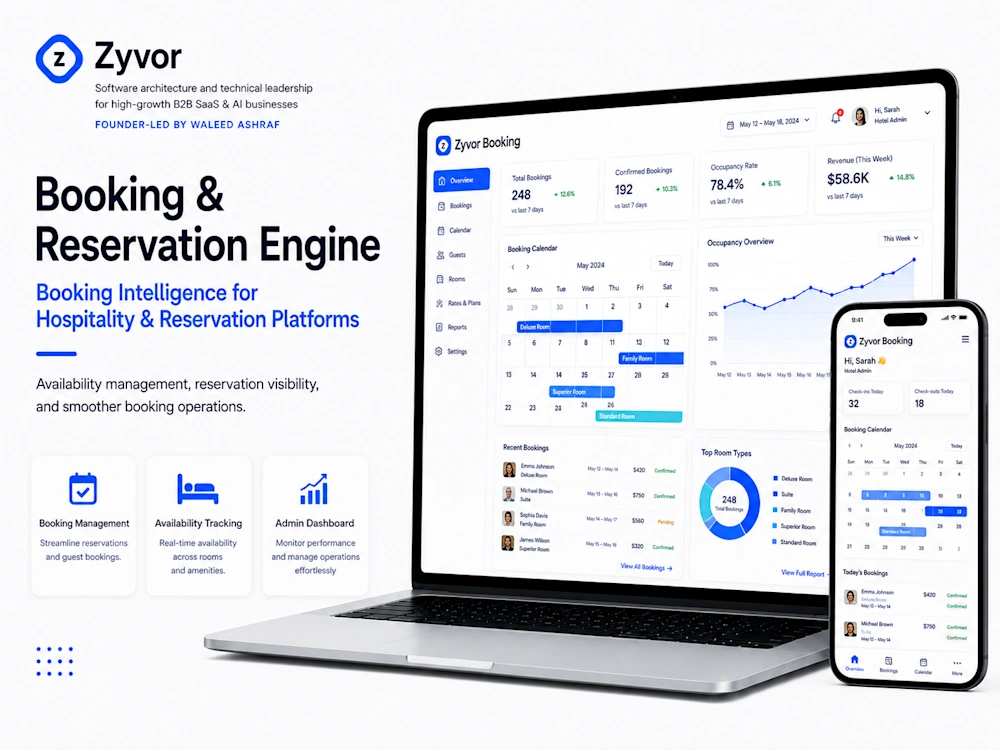
Booking & Reservation Engine

Booking management platform designed for appointment scheduling, availability management, payment processing, automated reminders, and client self-service across service-based businesses.

Booking & Reservation Engine project cover
MJ Facility ServicesJan 1, 2025 – Apr 30, 2025

measurable outcomes

Phone booking volume dropped 65%. Online bookings grew from 15% to 78% of total. Admin booking time reduced from 4 hours/day to 45 minutes
Double-bookings eliminated. Capacity utilization improved from 68% to 86%. Revenue per available hour increased 24% through better slot optimization
No-show rate dropped from 18% to 4%. Recovered revenue from reduced no-shows: ~$12,000/month. Rescheduling (vs. cancellation) rate improved 340%
Concrete result: Platform handling 600+ bookings/month with 78% self-service. Revenue per available hour up 24%. Client lifetime value up 38%. Admin booking time from 4 hours/day to 45 minutes

problem

What had to change.

Phone-based booking consumed 4 hours/day of admin time. Clients calling during business hours waited an average of 6 minutes on hold. 22% of callers hung up before reaching someone, representing lost revenue
The WordPress booking plugin couldn't handle service-specific availability rules. A 3-hour deep cleaning service and a 30-minute inspection used the same time slots. Double-bookings for overlapping service durations happened weekly
No automated reminders. No-show rate averaged 18%. Each no-show cost the business an average of $180 in lost revenue and wasted technician time
Payment collection was post-service. 12% of invoices went unpaid past 30 days. Chasing payments consumed 6 hours/week of admin time
Client rebooking was entirely manual. Repeat clients (65% of revenue) had to call and go through the full booking process every time. No saved preferences, no booking history, no quick-rebook option
No visibility into booking patterns. The business couldn't answer: Which services are most popular What times have the highest demand Where are the capacity gaps Pricing and staffing decisions were based on gut feel

execution

The implementation lanes behind the project.

Clients book in 2 minutes. No phone call needed.

Self-Service Booking Portal

  • Public booking page with service catalog, real-time availability, and instant confirmation. Mobile-optimized for the 72% of clients booking from phones
  • Service-specific duration and resource rules: a 3-hour deep clean blocks the right time window and assigns a qualified team, while a 30-minute inspection books a single technician
  • Location-based service availability showing only services offered in the client's area with accurate pricing for their zone
Phone booking volume dropped 65%. Online bookings grew from 15% to 78% of total. Admin booking time reduced from 4 hours/day to 45 minutes

Never double-book. Never leave capacity unused.

Intelligent Availability Management

  • Resource-aware scheduling that considers technician count, equipment availability, travel time between jobs, and service-specific requirements simultaneously
  • Dynamic availability that adjusts in real time as bookings are made, cancelled, or rescheduled. No stale calendar data
  • Capacity optimization suggestions identifying underutilized time slots and recommending promotional pricing to fill gaps
Double-bookings eliminated. Capacity utilization improved from 68% to 86%. Revenue per available hour increased 24% through better slot optimization

18% no-show rate → 4%.

Automated Reminder and No-Show Prevention

  • Multi-channel reminders: SMS 48 hours before, email 24 hours before, and SMS 2 hours before with one-tap confirm or reschedule options
  • Easy rescheduling: clients reschedule from the reminder message without calling. Freed slots immediately available for other bookings
  • No-show tracking with configurable policies: automatic rebooking fees, deposit requirements for repeat no-shows, and waitlist promotion for cancelled slots
No-show rate dropped from 18% to 4%. Recovered revenue from reduced no-shows: ~$12,000/month. Rescheduling (vs. cancellation) rate improved 340%

Get paid when they book, not when you chase them.

Upfront Payment Processing

  • Stripe integration with configurable payment rules: full payment upfront, deposit at booking with balance on completion, or post-service billing for corporate accounts
  • Automatic payment processing on booking confirmation with instant receipt and calendar event delivery
  • Refund and credit management for cancellations within policy windows, with automatic credit application on rebooking
Unpaid invoices past 30 days dropped from 12% to under 1%. Payment chasing time eliminated (was 6 hours/week). Cash flow improved with 78% of revenue collected at booking time

Turn one-time clients into regulars with zero friction.

Client Relationship and Rebooking

  • Client profiles with booking history, service preferences, property details, and communication log
  • One-click rebooking: repeat clients see their previous services pre-filled with preferred time slots and technicians
  • Automated follow-up sequences: post-service feedback request, rebooking reminder at the optimal interval based on service type, and seasonal service suggestions
Repeat booking rate improved from 42% to 61%. Average client lifetime value increased 38%. Rebooking friction reduced to a single click

Make the implementation usable after launch.

Architecture Handoff and Operating Model

  • Documented the key architecture decisions, tradeoffs, and ownership boundaries behind the work.
  • Connected delivery lanes to support, operations, and future product iteration instead of treating launch as the finish line.
  • Gave the team a clearer operating model for scaling the product without recreating the same bottlenecks.
Platform handling 600+ bookings/month with 78% self-service. Revenue per available hour up 24%. Client lifetime value up 38%. Admin booking time from 4 hours/day to 45 minutes

project depth

More context behind the Booking & Reservation Engine work.

Each selected project is read through business pressure, architecture tradeoffs, delivery sequencing, team operating model, role coverage, and stack fit so the case study stays useful for founders, CTOs, and product leaders evaluating similar work.

business pressure

Why the work mattered

The booking experience was the business's front door, and it was stuck in 2015. The project started from a real operational constraint, not a decorative rebuild, which made the architecture work accountable to business movement.

architecture pressure

PostgreSQL with advisory locks for booking concurrency

Two clients booking the same slot simultaneously is the core race condition in any booking system. Advisory locks on time-slot-resource combinations prevent double-bookings at the database level, not just the application level

implementation priority

Self-Service Booking Portal

Phone booking volume dropped 65%. Online bookings grew from 15% to 78% of total. Admin booking time reduced from 4 hours/day to 45 minutes

operating change

What changed for the team

Phone booking volume dropped 65%. Online bookings grew from 15% to 78% of total. Admin booking time reduced from 4 hours/day to 45 minutes

role coverage

Leadership and engineering coverage

The work called for software architect, technical lead, full-stack engineer, api engineer, backend engineer coverage, connecting strategy, implementation, and delivery quality instead of treating them as separate tracks.

stack fit

Technology choices in context

Laravel, Next.js, PostgreSQL, Stripe, React, Node.js were part of the delivery context, but the value came from how the stack supported maintainability, scalability, and a stronger path from architecture to production.

architecture decisions

Technical choices that mattered.

PostgreSQL with advisory locks for booking concurrency

Two clients booking the same slot simultaneously is the core race condition in any booking system. Advisory locks on time-slot-resource combinations prevent double-bookings at the database level, not just the application level

Stripe for payment processing over custom payment integration

PCI compliance, refund handling, dispute management, and receipt generation are solved problems. Stripe handles all of it. Custom integration would have added 4+ weeks and ongoing compliance overhead

Laravel for booking logic and queue processing

Booking confirmation triggers 5+ side effects: payment capture, calendar event creation, reminder scheduling, technician notification, and client confirmation. Laravel's queue system processes these asynchronously without blocking the booking response

Next.js with SSR for the public booking page

The booking page is the primary conversion surface. Server-rendered pages with real-time availability load in under 1 second. SEO-friendly for "[service] booking [city]" search queries driving organic traffic

operating model

Architecture changes were tied directly to how the software business would operate after launch.

Phone booking volume dropped 65%. Online bookings grew from 15% to 78% of total. Admin booking time reduced from 4 hours/day to 45 minutes
Double-bookings eliminated. Capacity utilization improved from 68% to 86%. Revenue per available hour increased 24% through better slot optimization
Platform handling 600+ bookings/month with 78% self-service. Revenue per available hour up 24%. Client lifetime value up 38%. Admin booking time from 4 hours/day to 45 minutes

results

What changed after the work.

Phone booking volume dropped 65%. Online bookings grew from 15% to 78% of total. Admin booking time reduced from 4 hours/day to 45 minutes
Double-bookings eliminated. Capacity utilization improved from 68% to 86%. Revenue per available hour increased 24% through better slot optimization
No-show rate dropped from 18% to 4%. Recovered revenue from reduced no-shows: ~$12,000/month. Rescheduling (vs. cancellation) rate improved 340%

Week 1

Self-service booking portal live. Online bookings jumped from 15% to 45% of total within the first week. Phone volume dropped immediately

Week 3

Automated reminders deployed. No-show rate started declining from 18%. Upfront payment collection active on all online bookings

Month 1

Online bookings at 78%. No-show rate at 6% and falling. Double-bookings eliminated. Capacity utilization climbing from 68% toward 86%

Month 2

No-show rate stabilized at 4%. Unpaid invoices past 30 days under 1%. Repeat booking rate improving from 42% toward 61%

Month 4

Platform handling 600+ bookings/month with 78% self-service. Revenue per available hour up 24%. Client lifetime value up 38%. Admin booking time from 4 hours/day to 45 minutes

Final outcome

Platform handling 600+ bookings/month with 78% self-service. Revenue per available hour up 24%. Client lifetime value up 38%. Admin booking time from 4 hours/day to 45 minutes

buyer relevance

Why this project belongs in Zyvor software architecture work.

Software architecture signal

Booking & Reservation Engine shows how architecture decisions can move from implementation detail into business leverage for professional services teams.

Technical leadership signal

The work connects software architect, technical lead, full-stack engineer responsibilities with delivery clarity, execution confidence, and a cleaner operating model.

Scale-readiness signal

Platform handling 600+ bookings/month with 78% self-service. Revenue per available hour up 24%. Client lifetime value up 38%. Admin booking time from 4 hours/day to 45 minutes

What kind of business is Booking & Reservation Engine most relevant for?

This project is most relevant for professional services and professional services teams that need stronger software architecture, clearer technical direction, and more reliable execution as product or operational complexity increases.

What did Zyvor focus on in this selected work?

I built a booking and reservation platform that handles self-service scheduling, service-specific availability, automated reminders, upfront payment collection, and client relationship management. Designed to convert more inquiries into bookings and more first-time clients into repeat clients. The work was framed around practical architecture decisions, delivery ownership, and measurable business outcomes rather than advisory language alone.

How does this support Zyvor's software architecture consulting focus?

Booking & Reservation Engine supports Zyvor's focus on B2B SaaS and AI software architecture consulting by connecting system design, technical leadership, scalability, and execution quality to a concrete project outcome: Platform handling 600+ bookings/month with 78% self-service. Revenue per available hour up 24%. Client lifetime value up 38%. Admin booking time from 4 hours/day to 45 minutes

What kind of technical leadership problem does this represent?

It represents the point where delivery pressure, architecture ownership, and business expectations start converging. In work like Booking & Reservation Engine, technical leadership is not only about writing code; it is about choosing the right sequence, reducing ambiguity, and giving the team a clearer execution model.

What should a founder or CTO notice in this project?

A founder or CTO should notice the link between the business problem and the technical system underneath it. The most important signal is not a tool choice by itself; it is how the architecture, implementation lanes, and operating model support a measurable business result.

Does this kind of work require a full rebuild?

Not always. The right engagement depends on where the risk sits. Some projects need a focused architecture reset, some need modernization, and some need new product development. Zyvor frames the work around the smallest practical path to stronger scalability, reliability, and delivery confidence.

Decision context

The booking experience was the business's front door, and it was stuck in 2015. That business pressure shaped the architecture choices, implementation order, and operating model behind the work.

Delivery leverage

Phone booking volume dropped 65%. Online bookings grew from 15% to 78% of total. Admin booking time reduced from 4 hours/day to 45 minutes This is the kind of delivery leverage Zyvor looks for: fewer bottlenecks, clearer ownership, and better execution rhythm.

Architecture handoff

The project covered Laravel, Next.js, PostgreSQL, Stripe, React while keeping the handoff focused on maintainability, future change, and leadership clarity instead of isolated implementation tasks.

Best-fit conversation

A similar engagement usually starts with the current bottleneck, the architecture decision that feels stuck, and the business risk that is becoming harder to ignore.