Professional Services selected work

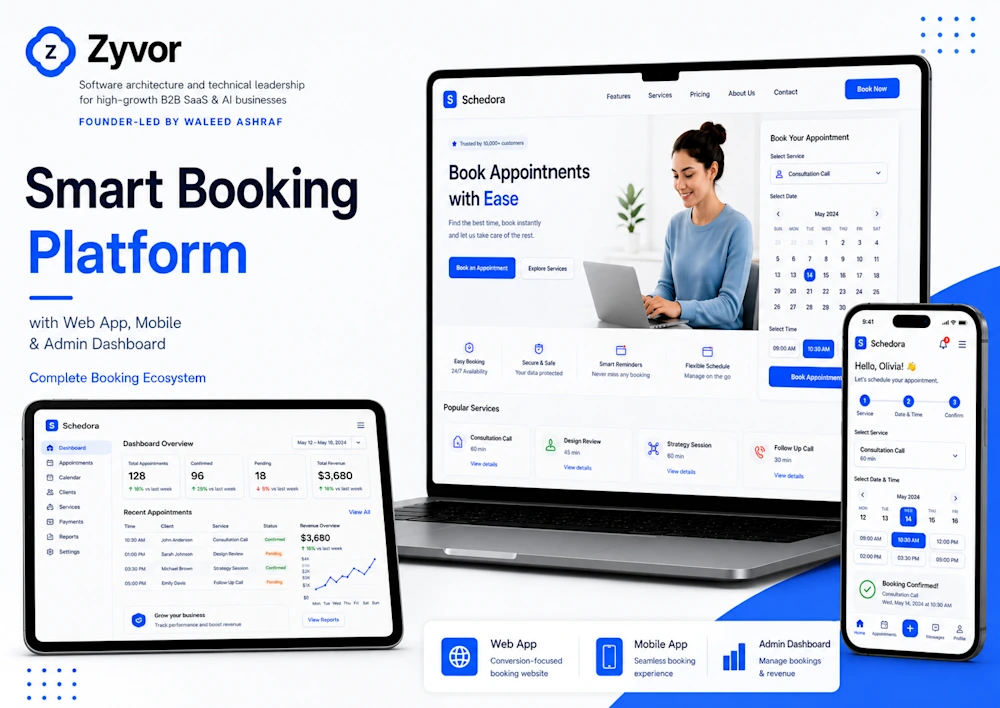
Smart Booking Platform

Booking ecosystem designed for appointment scheduling, calendar management, payment processing, automated reminders, and admin operations across service-based businesses.

Smart Booking Platform project cover
MJ Facility ServicesNov 1, 2022 – Feb 28, 2023

measurable outcomes

Online booking operational from launch day. 82% of bookings made outside business hours in the first month. Zero double-bookings from day one through constraint-based availability
92% of bookings paid at time of booking. Payment collection fully automated. Zero manual payment processing from launch
No-show rate at 5% from launch (vs. 15-20% industry average). Cancelled slots rebooked 68% of the time through automatic release and waitlist notifications
Concrete result: Consumer division fully operational on the platform. 300+ bookings/month. Capacity utilization at 84%. No-show rate holding at 5%. Repeat booking rate at 38%. Platform generating actionable demand forecasts 2-4 weeks ahead

problem

What had to change.

No online booking capability. The company's only booking channel was phone calls during business hours (8am-5pm). Consumer clients expected 24/7 online booking with instant confirmation. Competitors offered this as standard
No payment processing infrastructure. Commercial contracts were invoiced monthly, but consumer services needed upfront payment at booking. The company had no online payment capability and no Stripe or payment gateway integration
Calendar management was a shared Outlook calendar with no availability rules. Service duration, technician skills, equipment requirements, and travel time weren't factored into scheduling. Every booking required manual validation
No reminder system. The commercial division's no-show rate was low (contract clients are reliable), but consumer no-show rates in the industry average 15-20%. Without automated reminders, the new division would hemorrhage revenue from empty slots
No client self-service. Rescheduling, cancellation, and rebooking all required a phone call. Consumer clients expect to manage their bookings online, especially outside business hours
No booking analytics. The company couldn't project demand, identify popular time slots, or optimize pricing without historical booking data. Launch pricing and staffing were based on industry averages, not actual demand

execution

The implementation lanes behind the project.

24/7 booking. Instant confirmation. No phone required.

Online Booking Engine

  • Public booking page with service catalog, real-time availability grid, and instant booking confirmation with calendar invite delivery
  • Service-aware scheduling: each service type has configured duration, required skills, equipment needs, and buffer time. The availability engine only shows slots where all requirements are met
  • Mobile-first design: 78% of consumer bookings happen on mobile. The booking flow is optimized for thumb-friendly interaction with minimal form fields
Online booking operational from launch day. 82% of bookings made outside business hours in the first month. Zero double-bookings from day one through constraint-based availability

Book and pay in one flow.

Integrated Payment Processing

  • Stripe integration with configurable payment rules per service: full prepayment for standard services, deposit for premium services, and pay-on-completion for recurring clients
  • Automatic receipt delivery on payment with booking confirmation, service details, and cancellation policy
  • Refund automation: cancellations within the free cancellation window trigger instant refunds. Late cancellations retain the deposit per policy
92% of bookings paid at time of booking. Payment collection fully automated. Zero manual payment processing from launch

Reduce no-shows before they happen.

Smart Reminder System

  • Multi-channel reminders: SMS 48 hours before, email 24 hours before, and SMS 2 hours before with one-tap confirm or reschedule
  • Cancellation with automatic slot release: cancelled slots immediately become available for other clients. Waitlist notification for popular time slots
  • No-show tracking with progressive policies: first no-show gets a warning, second requires a deposit on future bookings, third requires full prepayment
No-show rate at 5% from launch (vs. 15-20% industry average). Cancelled slots rebooked 68% of the time through automatic release and waitlist notifications

Manage bookings anytime. No phone call needed.

Client Self-Service Portal

  • Client dashboard showing upcoming bookings, booking history, saved payment methods, and favorite services
  • Self-service rescheduling and cancellation with real-time availability and instant confirmation
  • One-click rebooking for repeat services with pre-filled details from previous bookings
85% of rescheduling handled through self-service (zero admin involvement). Repeat booking rate of 38% within the first 3 months. Client satisfaction score: 4.6/5

Data-driven decisions from day one.

Booking Analytics and Demand Intelligence

  • Real-time booking dashboard showing daily/weekly/monthly volume, revenue, popular services, peak times, and conversion rates
  • Demand forecasting using booking patterns to predict staffing needs 2-4 weeks ahead
  • Pricing optimization insights: identifying high-demand slots where premium pricing could increase revenue and low-demand slots where promotional pricing could fill capacity
Staffing decisions based on actual demand data within 6 weeks of launch. Peak-time identification enabling dynamic pricing that increased revenue per slot 15%. Capacity utilization optimized to 84% by month 3

Make the implementation usable after launch.

Architecture Handoff and Operating Model

  • Documented the key architecture decisions, tradeoffs, and ownership boundaries behind the work.
  • Connected delivery lanes to support, operations, and future product iteration instead of treating launch as the finish line.
  • Gave the team a clearer operating model for scaling the product without recreating the same bottlenecks.
Consumer division fully operational on the platform. 300+ bookings/month. Capacity utilization at 84%. No-show rate holding at 5%. Repeat booking rate at 38%. Platform generating actionable demand forecasts 2-4 weeks ahead

project depth

More context behind the Smart Booking Platform work.

Each selected project is read through business pressure, architecture tradeoffs, delivery sequencing, team operating model, role coverage, and stack fit so the case study stays useful for founders, CTOs, and product leaders evaluating similar work.

business pressure

Why the work mattered

The company was launching a consumer division with commercial-grade tools. It needed a purpose-built booking platform before the first client could schedule a service. The project started from a real operational constraint, not a decorative rebuild, which made the architecture work accountable to business movement.

architecture pressure

PostgreSQL with advisory locks for concurrent booking prevention

Consumer booking has high concurrency: multiple clients viewing the same available slot simultaneously. Advisory locks serialize booking attempts for the same slot, preventing double-bookings at the database level regardless of application-layer race conditions

implementation priority

Online Booking Engine

Online booking operational from launch day. 82% of bookings made outside business hours in the first month. Zero double-bookings from day one through constraint-based availability
operating change

What changed for the team

Online booking operational from launch day. 82% of bookings made outside business hours in the first month. Zero double-bookings from day one through constraint-based availability

role coverage

Leadership and engineering coverage

The work called for software architect, technical lead, full-stack engineer, backend engineer, api engineer coverage, connecting strategy, implementation, and delivery quality instead of treating them as separate tracks.

stack fit

Technology choices in context

AWS, Next.js, PostgreSQL, Stripe, React, Node.js were part of the delivery context, but the value came from how the stack supported maintainability, scalability, and a stronger path from architecture to production.

architecture decisions

Technical choices that mattered.

PostgreSQL with advisory locks for concurrent booking prevention

Consumer booking has high concurrency: multiple clients viewing the same available slot simultaneously. Advisory locks serialize booking attempts for the same slot, preventing double-bookings at the database level regardless of application-layer race conditions

Stripe Checkout for payment flow

Building a custom payment form means PCI compliance burden. Stripe Checkout handles the entire payment UI, card validation, 3D Secure, and receipt generation. Reduces development time and eliminates PCI scope

AWS SES for transactional email and SNS for SMS

Booking confirmations, reminders, and receipts need reliable delivery. SES handles email with delivery tracking. SNS handles SMS reminders. Both scale automatically with booking volume

Next.js with edge functions for the booking page

Booking page load speed directly impacts conversion. Edge functions serve the booking page from the nearest CDN location with real-time availability data. Sub-1-second page loads regardless of client location

operating model

Architecture changes were tied directly to how the software business would operate after launch.

Online booking operational from launch day. 82% of bookings made outside business hours in the first month. Zero double-bookings from day one through constraint-based availability
92% of bookings paid at time of booking. Payment collection fully automated. Zero manual payment processing from launch
Consumer division fully operational on the platform. 300+ bookings/month. Capacity utilization at 84%. No-show rate holding at 5%. Repeat booking rate at 38%. Platform generating actionable demand forecasts 2-4 weeks ahead

results

What changed after the work.

Online booking operational from launch day. 82% of bookings made outside business hours in the first month. Zero double-bookings from day one through constraint-based availability
92% of bookings paid at time of booking. Payment collection fully automated. Zero manual payment processing from launch
No-show rate at 5% from launch (vs. 15-20% industry average). Cancelled slots rebooked 68% of the time through automatic release and waitlist notifications

Week 1

Booking platform live on launch day. First 45 bookings in the first week, 82% made outside business hours. Zero double-bookings. Payment processing fully automated

Week 3

Reminder system active. No-show rate at 5% from the start. Self-service portal handling 70% of rescheduling requests

Month 1

150+ bookings/month. Cancelled slots rebooking at 68%. Client satisfaction at 4.6/5. Booking analytics providing first demand insights

Month 2

Demand patterns clear enough for staffing optimization. Peak-time pricing increasing revenue per slot 15%. Repeat booking rate at 30% and climbing

Month 4

Consumer division fully operational on the platform. 300+ bookings/month. Capacity utilization at 84%. No-show rate holding at 5%. Repeat booking rate at 38%. Platform generating actionable demand forecasts 2-4 weeks ahead

Final outcome

Consumer division fully operational on the platform. 300+ bookings/month. Capacity utilization at 84%. No-show rate holding at 5%. Repeat booking rate at 38%. Platform generating actionable demand forecasts 2-4 weeks ahead

buyer relevance

Why this project belongs in Zyvor software architecture work.

Software architecture signal

Smart Booking Platform shows how architecture decisions can move from implementation detail into business leverage for professional services teams.

Technical leadership signal

The work connects software architect, technical lead, full-stack engineer responsibilities with delivery clarity, execution confidence, and a cleaner operating model.

Scale-readiness signal

Consumer division fully operational on the platform. 300+ bookings/month. Capacity utilization at 84%. No-show rate holding at 5%. Repeat booking rate at 38%. Platform generating actionable demand forecasts 2-4 weeks ahead

What kind of business is Smart Booking Platform most relevant for?

This project is most relevant for professional services and professional services teams that need stronger software architecture, clearer technical direction, and more reliable execution as product or operational complexity increases.

What did Zyvor focus on in this selected work?

I built a booking platform from scratch for the consumer division: online scheduling with real-time availability, integrated payment processing, automated reminders, client self-service, and booking analytics. Designed to be the consumer division's operating system from day one. The work was framed around practical architecture decisions, delivery ownership, and measurable business outcomes rather than advisory language alone.

How does this support Zyvor's software architecture consulting focus?

Smart Booking Platform supports Zyvor's focus on B2B SaaS and AI software architecture consulting by connecting system design, technical leadership, scalability, and execution quality to a concrete project outcome: Consumer division fully operational on the platform. 300+ bookings/month. Capacity utilization at 84%. No-show rate holding at 5%. Repeat booking rate at 38%. Platform generating actionable demand forecasts 2-4 weeks ahead

What kind of technical leadership problem does this represent?

It represents the point where delivery pressure, architecture ownership, and business expectations start converging. In work like Smart Booking Platform, technical leadership is not only about writing code; it is about choosing the right sequence, reducing ambiguity, and giving the team a clearer execution model.

What should a founder or CTO notice in this project?

A founder or CTO should notice the link between the business problem and the technical system underneath it. The most important signal is not a tool choice by itself; it is how the architecture, implementation lanes, and operating model support a measurable business result.

Does this kind of work require a full rebuild?

Not always. The right engagement depends on where the risk sits. Some projects need a focused architecture reset, some need modernization, and some need new product development. Zyvor frames the work around the smallest practical path to stronger scalability, reliability, and delivery confidence.

Decision context

The company was launching a consumer division with commercial-grade tools. It needed a purpose-built booking platform before the first client could schedule a service. That business pressure shaped the architecture choices, implementation order, and operating model behind the work.

Delivery leverage

Online booking operational from launch day. 82% of bookings made outside business hours in the first month. Zero double-bookings from day one through constraint-based availability This is the kind of delivery leverage Zyvor looks for: fewer bottlenecks, clearer ownership, and better execution rhythm.

Architecture handoff

The project covered AWS, Next.js, PostgreSQL, Stripe, React while keeping the handoff focused on maintainability, future change, and leadership clarity instead of isolated implementation tasks.

Best-fit conversation

A similar engagement usually starts with the current bottleneck, the architecture decision that feels stuck, and the business risk that is becoming harder to ignore.