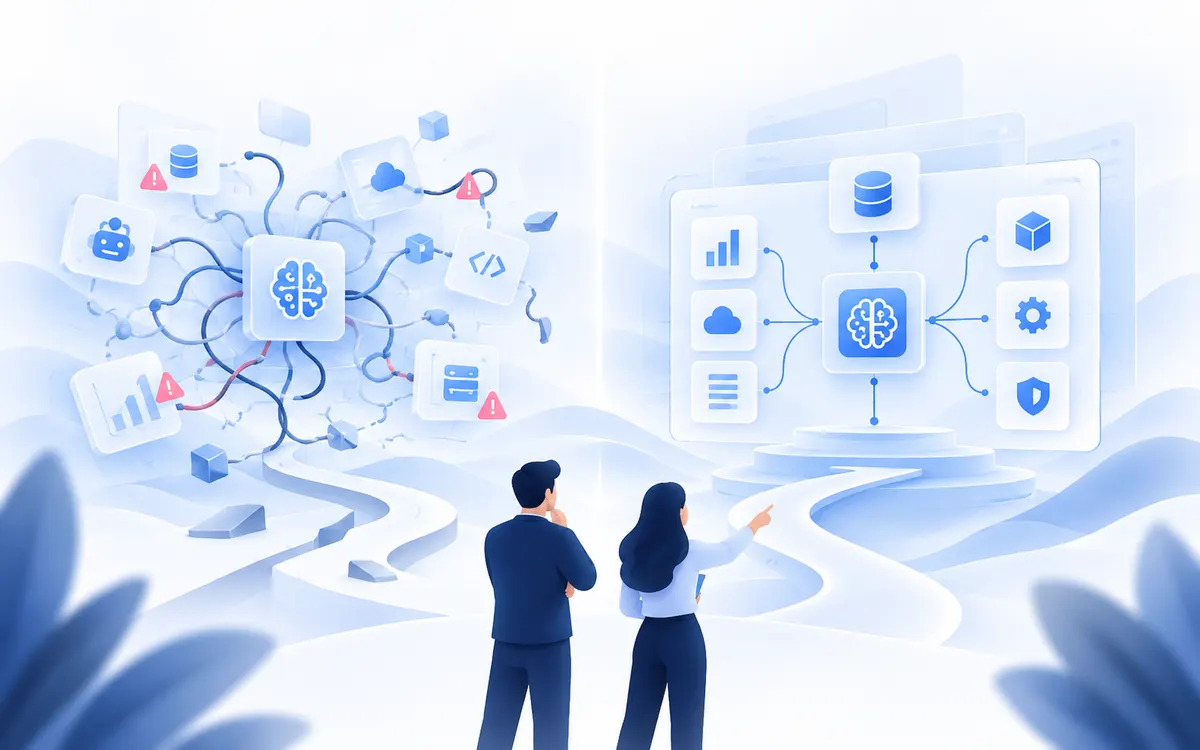
ai product architecture insight

AI product architecture readiness for B2B SaaS

A readiness guide for B2B SaaS teams adding AI product capabilities without creating fragile workflows, unclear ownership, or avoidable reliability risk.

Why this matters

AI product architecture readiness is the difference between an impressive demo and a dependable customer workflow. Once AI touches paid product behavior, teams need clearer decisions around data flow, model ownership, observability, latency, fallback behavior, and support readiness.

insight brief

The business-readable version before the deeper architecture detail.

This brief turns the article topic into a founder and CTO decision frame: what is happening, why it matters, and how to move from reading into a useful technical conversation.

The problem pattern

AI product architecture readiness is the difference between an impressive demo and a dependable customer workflow. Once AI touches paid product behavior, teams need clearer decisions around data flow, model ownership, observability, latency, fallback behavior, and support readiness.

What leaders should notice

AI features are being shipped before customer-facing failure modes are clearly designed.

Why it matters commercially

This matters because architecture pressure rarely stays technical for long. It usually becomes delivery drag, customer trust risk, support load, hiring confusion, or roadmap uncertainty.

How Zyvor frames the response

The response is tied to ai architecture consulting, saas and ai product development, performance optimization, with enough practical detail for a founder, CTO, or engineering team to decide what should happen next.

This insight is intentionally written for growth-stage decision-making, not abstract engineering theory. The question is not only whether ai product architecture readiness for b2b saas is technically interesting; the question is whether it is already affecting delivery quality, customer confidence, architecture clarity, or leadership focus.
The best next step is to connect the signal to the real operating context. That means understanding where the symptom appears, who currently owns the decision, what customer or roadmap pressure is increasing, and whether the team has enough architecture clarity to move without creating more drag.
For Zyvor, the useful output is a decision path: what to inspect first, what to stabilize, what to defer, and which architecture or technical leadership move will create the most leverage for a US or UK high-growth B2B SaaS or AI business.

AI readiness starts with ownership clarity.

Teams need to know who owns model behavior, workflow logic, prompt quality, data access, support diagnosis, and reliability decisions. Without that clarity, AI functionality becomes harder to improve as customer usage grows.

Observability is not optional when AI becomes customer-facing.

AI-enabled workflows need visibility into latency, error states, fallback usage, data retrieval behavior, model responses, and customer impact. Without observability, leaders cannot tell whether the product is improving or quietly increasing support risk.

Technical leadership should shape the AI sequence before sales pressure does.

The safest path is to decide which AI workflows are ready for broader rollout, which need stronger controls, and which should remain experimental. That sequence is a technical leadership decision as much as a product decision.

Best fit

The teams that usually benefit most from acting on this insight.

Useful for US and UK high-growth B2B SaaS and AI businesses where delivery pressure is starting to expose architectural drift.
Especially relevant when founders, CTOs, or engineering leaders need a clearer software architecture decision path before complexity compounds.
Best for teams that want practical guidance tied to business growth, not generic architecture theory.

Likely outcomes

What improves when the architecture and leadership response gets sharper.

Sharper software architecture decisions before delivery drag becomes expensive.
Stronger technical leadership framing around priorities, sequencing, and ownership.
Clearer scale-readiness planning before customer growth creates avoidable risk.

proof in context

The same themes in this insight already show up in client and leadership feedback.

Zyvor is positioned around architecture clarity, stronger technical leadership, and safer scale decisions. These reviews reinforce that those themes are already visible in real delivery work.

Contra review

Waleed brought the architectural foresight we needed to turn an early marketplace vision into a platform ready for growth. The system design gave us confidence in booking, payments, and the next stage of scale.

Mubeen Malik

Client, Opsure

Contra review

What stood out was the combination of strong architectural thinking and practical execution. Complex requirements were translated into clear solutions that improved scalability and performance without losing business context.

Fahad Hussain

Client

faq

Questions business and technical leaders usually ask next.

What is the biggest AI architecture readiness mistake?

The biggest mistake is treating AI as a standalone feature rather than a system behavior that changes data flow, reliability, cost, latency, support, and customer trust.

Does every AI feature need heavy architecture work?

No. Internal experiments can stay lightweight. Customer-facing AI workflows need more architecture discipline because reliability, explainability, and support expectations are higher.

Which Zyvor services connect most closely to this insight?

This topic usually connects to ai architecture consulting, saas and ai product development, performance optimization. The right service path depends on whether the business needs architecture audit clarity, technical leadership, AI architecture, modernization, performance improvement, or full-stack product execution.

How should a founder or CTO act on this insight?

Start by identifying where the pattern is already visible in the business: ai features are being shipped before customer-facing failure modes are clearly designed. From there, the next step is to connect the symptom to architecture decisions, leadership ownership, customer impact, and the sequence of work that would create the most leverage.

Is this insight more strategic or implementation-focused?

It is both. Zyvor content is written for leaders who need strategic clarity, but the recommendations stay close to implementation realities so architecture direction can become product, engineering, and operating decisions.

Why is this relevant for US and UK high-growth B2B SaaS and AI businesses?

Those businesses usually face stronger buyer expectations, faster roadmap pressure, and more complex architecture decisions at the same time. The content is shaped around that growth-stage reality rather than generic engineering theory.

buyer readiness signals

This topic is worth acting on when ai features are being shipped before customer-facing failure modes are clearly designed.
It becomes more urgent when prompt, model, data, and workflow ownership are spread across product and engineering without a clear operating model.
It usually needs leadership attention when latency and cost behavior are not visible enough to support larger customer usage.
It should move into a focused architecture conversation when the team lacks rollout controls, fallback paths, or support diagnostics for ai-assisted workflows.

decision support

Name the business pressure first: customer trust, roadmap confidence, hiring clarity, enterprise readiness, AI risk, or reliability.
Identify the current owner of the decision and whether that ownership is explicit enough for the next stage.
Separate the visible symptom from the architecture, product, data, or leadership cause underneath it.
Decide what should be clarified before more engineering time, product commitments, or customer promises are added.

next step

Move from insight into a relevant software architecture conversation.

If this problem feels familiar, the fastest next move is to talk through the software architecture issue, technical leadership gap, or scale-readiness pressure directly.

Which current software architecture decision is slowing releases or confidence?
Where is technical leadership stretched between delivery pressure and longer-term system direction?
What would need to become clearer before the next stage of customer or platform growth?

what the conversation produces

A sharper view of the architecture or leadership constraint behind the visible symptom.
A practical next-step sequence tied to delivery confidence, customer risk, or growth readiness.
A clear service direction: audit, technical leadership, AI architecture, modernization, performance, or product execution.

practical next sequence

Map the current symptom to the product workflow, customer journey, or platform area where it is showing up.
Separate architecture causes from process noise so the team does not solve the wrong problem cleanly.
Choose the smallest high-leverage sequence that improves delivery confidence, ownership, and customer trust.
Decide whether the right next move is audit, advisory, modernization, AI architecture, performance, or full-stack execution.

useful context to bring

Recent examples of slow releases, incidents, support pressure, or architecture decisions that keep resurfacing.
The roadmap, customer, enterprise, or AI pressure that makes the problem more urgent now.
The team roles currently involved in the decision and where ownership feels unclear.
What would make leadership feel more confident in the next 30 to 90 days.

review frame

Current state

What is already slowing the team, creating customer risk, or making architecture decisions harder to defend?

Decision owner

Who can make the next technical decision, and what context do they need before committing the team?

Business pressure

Which customer, roadmap, enterprise, AI, reliability, or hiring pressure makes this worth addressing now?

Useful output

A clear next sequence that connects architecture judgment with delivery, product, and leadership action.

service fit guide

Use an audit when the system risk is unclear.
Use advisory when leadership needs sharper decision support.
Use modernization when legacy drag is shaping roadmap work.
Use performance or AI architecture when customer-facing reliability is becoming trust risk.