Healthcare selected work

HealthSync Care

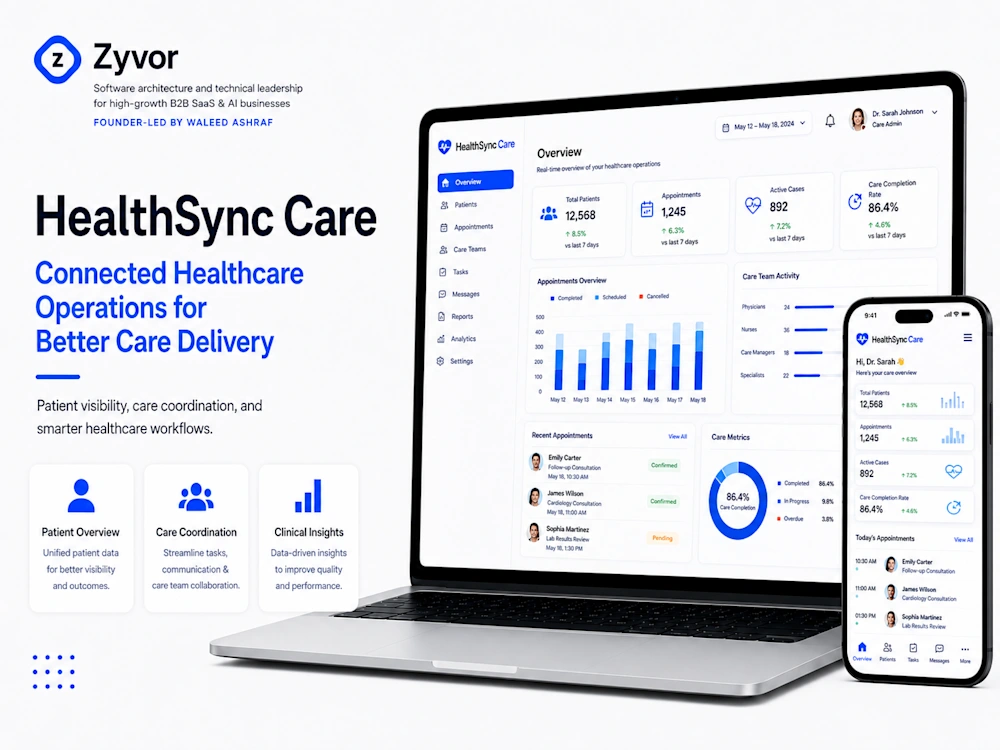
Care management platform designed for participant plan management, service coordination, staff scheduling, compliance reporting, and operational control for disability service providers.

HealthSync Care project cover
Salvus CareOct 1, 2024 – Jan 31, 2025

measurable outcomes

Over-budget discoveries dropped from 4-6 week lag to real-time alerts. Coordinators managing 40% more participants per caseload with structured plan views replacing spreadsheet hunting
Service booking time dropped from 25 minutes per appointment to 3 minutes. Participant-worker continuity improved 58%, directly impacting care quality scores
Quarterly audit prep dropped from 3 weeks to 2 days. NDIS claim rejection rate reduced from 12% to under 2%. Zero compliance findings in the first post-launch audit
Concrete result: First post-launch NDIS audit completed with zero findings. 100% credential compliance maintained. Platform managing 340+ participants across 3 regions with full audit trail

problem

What had to change.

Participant plan management lived in individual spreadsheets. Each coordinator maintained their own files with no standardized format. When a coordinator went on leave, nobody could pick up their caseload without 2+ days of context gathering
Service booking and scheduling was done via phone and email. Coordinators manually matched participants with available support workers based on memory and a shared Google Calendar that was perpetually out of date
NDIS compliance reporting required pulling data from 6 different sources, cross-referencing participant plans, and manually calculating budget utilization. Each quarterly audit prep took 3 weeks of dedicated admin work
Budget tracking was reactive. Coordinators discovered participants had exceeded their plan budgets only when NDIS rejected claims. Average over-budget discovery lag: 4-6 weeks
Incident reporting was paper-based. Forms were filled on-site, physically delivered to the office, and manually entered into a spreadsheet. Critical incidents sometimes took 48+ hours to reach management
Staff credential tracking (Working with Children checks, first aid certifications, NDIS Worker Screening) was managed in a master spreadsheet. Expired credentials were caught during audits, not before they expired

execution

The implementation lanes behind the project.

Every participant's plan, budget, goals, and service history in one place.

Participant Plan Management

  • Structured plan records with NDIS line items, budget allocations, goal tracking, and review dates with automatic renewal reminders
  • Real-time budget utilization tracking showing spend against each line item with projected exhaustion dates
  • Plan transition workflows handling the handoff between expiring and new plans without service gaps
Over-budget discoveries dropped from 4-6 week lag to real-time alerts. Coordinators managing 40% more participants per caseload with structured plan views replacing spreadsheet hunting

Match the right support worker to the right participant, automatically.

Intelligent Service Coordination

  • Availability-based scheduling matching participant needs (service type, location, language, gender preference) with qualified available support workers
  • Shift management with automatic conflict detection, overtime tracking, and travel time calculations between participant locations
  • Participant-worker relationship continuity tracking, prioritizing familiar workers for recurring services
Service booking time dropped from 25 minutes per appointment to 3 minutes. Participant-worker continuity improved 58%, directly impacting care quality scores

Audit-ready every day, not just during audit prep.

Automated Compliance Engine

  • NDIS claim generation with automatic line item matching, rate validation, and submission-ready export in NDIS bulk upload format
  • Continuous compliance monitoring checking service delivery records against plan authorizations, worker qualifications, and NDIS Practice Standards
  • Audit trail on every action: who changed what, when, and why. Immutable logs that satisfy NDIS Quality and Safeguards Commission requirements
Quarterly audit prep dropped from 3 weeks to 2 days. NDIS claim rejection rate reduced from 12% to under 2%. Zero compliance findings in the first post-launch audit

Critical incidents reach management in minutes, not days.

Real-Time Incident Management

  • Mobile incident reporting with structured forms, photo capture, and severity classification submitted from the field in real time
  • Automatic escalation routing: critical incidents notify management immediately, standard incidents queue for review within 24 hours
  • Incident trend analytics showing patterns by participant, location, service type, and time period for proactive risk management
Incident reporting lag dropped from 48+ hours to under 15 minutes. Management response time to critical incidents improved from next-day to under 1 hour

Never send an unqualified worker to a participant.

Staff Credential and Compliance Tracking

  • Centralized credential registry tracking expiry dates for all mandatory certifications (WWCC, first aid, NDIS Worker Screening, driver's license)
  • Automatic alerts at 90, 60, and 30 days before expiry with renewal workflow tracking
  • Scheduling system blocks assignment of workers with expired or missing credentials, preventing compliance violations before they happen
Expired credential incidents dropped to zero. 100% credential compliance maintained continuously. Scheduling blocks prevented 23 potential compliance violations in the first quarter

Make the implementation usable after launch.

Architecture Handoff and Operating Model

  • Documented the key architecture decisions, tradeoffs, and ownership boundaries behind the work.
  • Connected delivery lanes to support, operations, and future product iteration instead of treating launch as the finish line.
  • Gave the team a clearer operating model for scaling the product without recreating the same bottlenecks.
First post-launch NDIS audit completed with zero findings. 100% credential compliance maintained. Platform managing 340+ participants across 3 regions with full audit trail

project depth

More context behind the HealthSync Care work.

Each selected project is read through business pressure, architecture tradeoffs, delivery sequencing, team operating model, role coverage, and stack fit so the case study stays useful for founders, CTOs, and product leaders evaluating similar work.

business pressure

Why the work mattered

The provider wasn't cutting corners. They were buried under a compliance framework that demanded precision from systems built for approximation. The project started from a real operational constraint, not a decorative rebuild, which made the architecture work accountable to business movement.

architecture pressure

PostgreSQL with row-level security for participant data

NDIS participant data requires strict access controls. Row-level security policies ensure coordinators only see their assigned participants, while managers see regional views. Audit logging captures every data access, not just modifications

implementation priority

Participant Plan Management

Over-budget discoveries dropped from 4-6 week lag to real-time alerts. Coordinators managing 40% more participants per caseload with structured plan views replacing spreadsheet hunting

operating change

What changed for the team

Over-budget discoveries dropped from 4-6 week lag to real-time alerts. Coordinators managing 40% more participants per caseload with structured plan views replacing spreadsheet hunting

role coverage

Leadership and engineering coverage

The work called for software architect, technical lead, full-stack engineer, backend engineer, api engineer coverage, connecting strategy, implementation, and delivery quality instead of treating them as separate tracks.

stack fit

Technology choices in context

Next.js, Node.js, PostgreSQL, AWS, React, TypeScript were part of the delivery context, but the value came from how the stack supported maintainability, scalability, and a stronger path from architecture to production.

architecture decisions

Technical choices that mattered.

PostgreSQL with row-level security for participant data

NDIS participant data requires strict access controls. Row-level security policies ensure coordinators only see their assigned participants, while managers see regional views. Audit logging captures every data access, not just modifications

Docker for deployment consistency

Healthcare compliance requires reproducible environments. Containerized deployment ensures staging and production are identical, and rollbacks are instant if a release introduces issues during business hours

AWS with Sydney region data residency

NDIS participant data must remain in Australia. All infrastructure deployed in ap-southeast-2 with no cross-region replication. S3 bucket policies enforce geographic data residency

Next.js with offline-capable PWA for field workers

Support workers operate in areas with unreliable mobile coverage. Service worker caching allows incident reports and service notes to be drafted offline and synced when connectivity returns. Zero data loss from coverage gaps

operating model

Architecture changes were tied directly to how the software business would operate after launch.

Over-budget discoveries dropped from 4-6 week lag to real-time alerts. Coordinators managing 40% more participants per caseload with structured plan views replacing spreadsheet hunting
Service booking time dropped from 25 minutes per appointment to 3 minutes. Participant-worker continuity improved 58%, directly impacting care quality scores
First post-launch NDIS audit completed with zero findings. 100% credential compliance maintained. Platform managing 340+ participants across 3 regions with full audit trail

results

What changed after the work.

Over-budget discoveries dropped from 4-6 week lag to real-time alerts. Coordinators managing 40% more participants per caseload with structured plan views replacing spreadsheet hunting
Service booking time dropped from 25 minutes per appointment to 3 minutes. Participant-worker continuity improved 58%, directly impacting care quality scores
Quarterly audit prep dropped from 3 weeks to 2 days. NDIS claim rejection rate reduced from 12% to under 2%. Zero compliance findings in the first post-launch audit

Week 1

Participant plans migrated from spreadsheets. Real-time budget tracking live. Over-budget alerts catching issues same-day instead of 4-6 weeks later

Week 3

Service coordination automated. Booking time dropped from 25 minutes to 3 minutes per appointment. Worker-participant continuity tracking active

Month 1

Incident reporting digitized. Critical incident response time improved from next-day to under 1 hour. Credential tracking preventing 8 potential compliance violations

Month 2

NDIS claim rejection rate dropped from 12% to under 2%. Coordinators managing 40% larger caseloads. Quarterly audit prep estimated at 2 days vs. previous 3 weeks

Month 5

First post-launch NDIS audit completed with zero findings. 100% credential compliance maintained. Platform managing 340+ participants across 3 regions with full audit trail

Final outcome

First post-launch NDIS audit completed with zero findings. 100% credential compliance maintained. Platform managing 340+ participants across 3 regions with full audit trail

buyer relevance

Why this project belongs in Zyvor software architecture work.

Software architecture signal

HealthSync Care shows how architecture decisions can move from implementation detail into business leverage for healthcare teams.

Technical leadership signal

The work connects software architect, technical lead, full-stack engineer responsibilities with delivery clarity, execution confidence, and a cleaner operating model.

Scale-readiness signal

First post-launch NDIS audit completed with zero findings. 100% credential compliance maintained. Platform managing 340+ participants across 3 regions with full audit trail

What kind of business is HealthSync Care most relevant for?

This project is most relevant for healthcare and healthcare teams that need stronger software architecture, clearer technical direction, and more reliable execution as product or operational complexity increases.

What did Zyvor focus on in this selected work?

I built a care management platform purpose-built for NDIS providers, handling participant plans, service coordination, compliance reporting, and staff management in a single system. Every feature designed around the question: "Will this survive an audit" The work was framed around practical architecture decisions, delivery ownership, and measurable business outcomes rather than advisory language alone.

How does this support Zyvor's software architecture consulting focus?

HealthSync Care supports Zyvor's focus on B2B SaaS and AI software architecture consulting by connecting system design, technical leadership, scalability, and execution quality to a concrete project outcome: First post-launch NDIS audit completed with zero findings. 100% credential compliance maintained. Platform managing 340+ participants across 3 regions with full audit trail

What kind of technical leadership problem does this represent?

It represents the point where delivery pressure, architecture ownership, and business expectations start converging. In work like HealthSync Care, technical leadership is not only about writing code; it is about choosing the right sequence, reducing ambiguity, and giving the team a clearer execution model.

What should a founder or CTO notice in this project?

A founder or CTO should notice the link between the business problem and the technical system underneath it. The most important signal is not a tool choice by itself; it is how the architecture, implementation lanes, and operating model support a measurable business result.

Does this kind of work require a full rebuild?

Not always. The right engagement depends on where the risk sits. Some projects need a focused architecture reset, some need modernization, and some need new product development. Zyvor frames the work around the smallest practical path to stronger scalability, reliability, and delivery confidence.

Decision context

The provider wasn't cutting corners. They were buried under a compliance framework that demanded precision from systems built for approximation. That business pressure shaped the architecture choices, implementation order, and operating model behind the work.

Delivery leverage

Over-budget discoveries dropped from 4-6 week lag to real-time alerts. Coordinators managing 40% more participants per caseload with structured plan views replacing spreadsheet hunting This is the kind of delivery leverage Zyvor looks for: fewer bottlenecks, clearer ownership, and better execution rhythm.

Architecture handoff

The project covered Next.js, Node.js, PostgreSQL, AWS, React while keeping the handoff focused on maintainability, future change, and leadership clarity instead of isolated implementation tasks.

Best-fit conversation

A similar engagement usually starts with the current bottleneck, the architecture decision that feels stuck, and the business risk that is becoming harder to ignore.