FinTech & Payments selected work

FinFlow Finance Suite

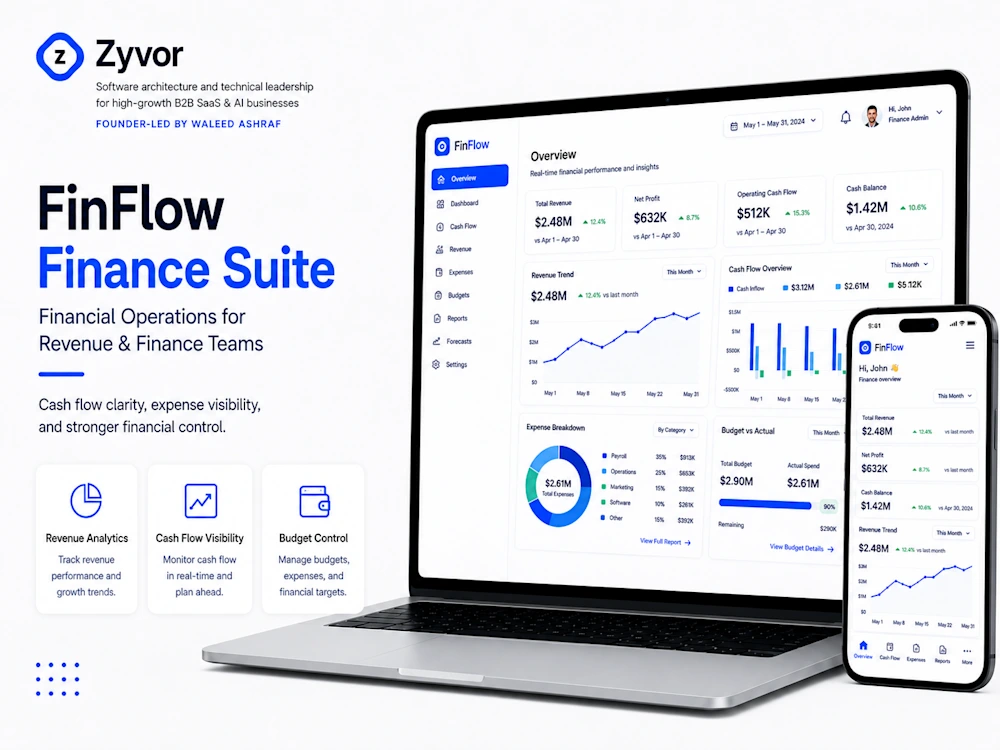
Financial operations platform designed for invoicing, payment processing, expense tracking, financial reporting, and cash flow management across service-based businesses.

FinFlow Finance Suite project cover
GMS PaintsDec 1, 2023 – Mar 31, 2024

measurable outcomes

Invoice creation time dropped from 18 minutes to under 1 minute (review only). Monthly invoicing effort from 30+ hours to 3 hours. Billing accuracy improved to 99.8%
Unmatched payments dropped from 15% to under 2%. Daily reconciliation time from 90 minutes to 10 minutes. Payment application lag eliminated
Monthly expense processing from 3 full days to 4 hours. Receipt loss eliminated. Expense report submission lag from 2+ weeks to same-day
Concrete result: DSO stabilized at 28 days. Invoices past 60 days under 1%. Finance team spending 80% on analysis and planning vs. 80% on data entry previously. Cash flow surprises eliminated

problem

What had to change.

Invoice creation was semi-manual. The admin pulled job completion data from the operations system, manually calculated line items based on contract rates, and created invoices in Xero one by one. Average time per invoice: 18 minutes. With 100+ invoices per month, this consumed 30+ hours
Payment tracking was a daily bank statement review. The finance manager manually matched incoming payments to outstanding invoices in a spreadsheet. Unmatched payments averaged 15% at any given time, requiring investigation
Expense tracking was receipt-based. Employees submitted paper receipts or forwarded email receipts to a shared inbox. The finance team manually categorized and entered each expense. Monthly expense processing took 3 full days
Cash flow visibility was backward-looking only. The business knew what happened last month but couldn't project next month's cash position. Seasonal demand swings caught them off guard twice a year
Financial reporting required exporting data from Xero, the operations system, and the expense spreadsheet, then manually combining them in Excel. Monthly financial close took 8 business days
Late payment follow-up was manual. The admin reviewed aging reports weekly and sent individual reminder emails. Average days sales outstanding (DSO): 42 days. 8% of invoices went past 60 days

execution

The implementation lanes behind the project.

Service completed → invoice created. Zero manual entry.

Automated Invoice Generation

  • Automatic invoice generation triggered by job completion, pulling service details, contract rates, materials used, and applicable taxes from the operations system
  • Batch invoicing for contract clients with configurable billing cycles and automatic line item aggregation across multiple completed jobs
  • Invoice approval workflow: auto-generated invoices queued for quick review before sending, with one-click approve or edit-and-approve
Invoice creation time dropped from 18 minutes to under 1 minute (review only). Monthly invoicing effort from 30+ hours to 3 hours. Billing accuracy improved to 99.8%

Payments matched to invoices without touching a spreadsheet.

Automatic Payment Reconciliation

  • Bank feed integration with automatic payment-to-invoice matching using amount, reference number, and client account heuristics
  • Partial payment handling with automatic balance tracking and follow-up scheduling for remaining amounts
  • Unmatched payment queue with AI-suggested matches for manual review, reducing investigation time from 20 minutes to 2 minutes per item
Unmatched payments dropped from 15% to under 2%. Daily reconciliation time from 90 minutes to 10 minutes. Payment application lag eliminated

Photograph the receipt. Done.

Digital Expense Management

  • Mobile expense capture: photograph receipt, auto-extract amount/vendor/date via OCR, select category, submit. Total time: 30 seconds
  • Approval workflows for expenses above configurable thresholds with manager review and budget impact visibility
  • Automatic categorization learning from historical patterns, reducing manual category selection to confirmation-only for 85% of expenses
Monthly expense processing from 3 full days to 4 hours. Receipt loss eliminated. Expense report submission lag from 2+ weeks to same-day

See today's position. Project next month's.

Real-Time Cash Flow Management

  • Real-time cash position dashboard combining bank balances, outstanding receivables, pending payables, and committed expenses
  • Cash flow forecasting using historical patterns, seasonal adjustments, and known upcoming commitments (payroll, rent, supplier payments)
  • Scenario modeling: "What if DSO increases 5 days" or "What if we lose our largest client" with instant impact visualization
Cash flow visibility from backward-looking monthly to real-time with 90-day forward projection. Seasonal cash crunches anticipated 60+ days in advance. Zero cash flow surprises since launch

Get paid faster. Close the books faster.

Automated Collections and Reporting

  • Automated payment reminders at configurable intervals (7 days, 14 days, 30 days overdue) with escalating tone and payment link included
  • Aging report with automatic follow-up scheduling and escalation to management for accounts past threshold
  • One-click monthly financial close pulling all data sources into consolidated P&L, balance sheet, and cash flow statement
DSO dropped from 42 days to 28 days. Invoices past 60 days reduced from 8% to under 1%. Monthly financial close from 8 business days to 2

Make the implementation usable after launch.

Architecture Handoff and Operating Model

  • Documented the key architecture decisions, tradeoffs, and ownership boundaries behind the work.
  • Connected delivery lanes to support, operations, and future product iteration instead of treating launch as the finish line.
  • Gave the team a clearer operating model for scaling the product without recreating the same bottlenecks.
DSO stabilized at 28 days. Invoices past 60 days under 1%. Finance team spending 80% on analysis and planning vs. 80% on data entry previously. Cash flow surprises eliminated

project depth

More context behind the FinFlow Finance Suite work.

Each selected project is read through business pressure, architecture tradeoffs, delivery sequencing, team operating model, role coverage, and stack fit so the case study stays useful for founders, CTOs, and product leaders evaluating similar work.

business pressure

Why the work mattered

The finance team was a data entry department that occasionally did finance. The project started from a real operational constraint, not a decorative rebuild, which made the architecture work accountable to business movement.

architecture pressure

PostgreSQL with double-entry accounting schema

Financial data requires absolute consistency. Double-entry ledger tables ensure every transaction balances. Database constraints prevent unbalanced entries at the schema level, not just the application level

implementation priority

Automated Invoice Generation

Invoice creation time dropped from 18 minutes to under 1 minute (review only). Monthly invoicing effort from 30+ hours to 3 hours. Billing accuracy improved to 99.8%

operating change

What changed for the team

Invoice creation time dropped from 18 minutes to under 1 minute (review only). Monthly invoicing effort from 30+ hours to 3 hours. Billing accuracy improved to 99.8%

role coverage

Leadership and engineering coverage

The work called for software architect, technical lead, backend engineer, api engineer, full-stack engineer coverage, connecting strategy, implementation, and delivery quality instead of treating them as separate tracks.

stack fit

Technology choices in context

AWS, Next.js, PostgreSQL, Stripe, React, Node.js were part of the delivery context, but the value came from how the stack supported maintainability, scalability, and a stronger path from architecture to production.

architecture decisions

Technical choices that mattered.

PostgreSQL with double-entry accounting schema

Financial data requires absolute consistency. Double-entry ledger tables ensure every transaction balances. Database constraints prevent unbalanced entries at the schema level, not just the application level

Stripe for payment processing and bank feed integration

Stripe's Financial Connections API provides read-only bank feed access for reconciliation. Combined with Stripe Invoicing for payment collection, the entire payment lifecycle stays in one ecosystem

AWS Lambda for scheduled financial jobs

Reminder emails, aging report generation, and cash flow recalculation run on schedules. Lambda handles these batch jobs without maintaining always-on infrastructure for tasks that run minutes per day

Next.js with real-time WebSocket for cash flow dashboard

Cash position changes with every payment received and every expense recorded. WebSocket pushes update the dashboard in real time without polling. Server-rendered initial load with client-side live updates

operating model

Architecture changes were tied directly to how the software business would operate after launch.

Invoice creation time dropped from 18 minutes to under 1 minute (review only). Monthly invoicing effort from 30+ hours to 3 hours. Billing accuracy improved to 99.8%
Unmatched payments dropped from 15% to under 2%. Daily reconciliation time from 90 minutes to 10 minutes. Payment application lag eliminated
DSO stabilized at 28 days. Invoices past 60 days under 1%. Finance team spending 80% on analysis and planning vs. 80% on data entry previously. Cash flow surprises eliminated

results

What changed after the work.

Invoice creation time dropped from 18 minutes to under 1 minute (review only). Monthly invoicing effort from 30+ hours to 3 hours. Billing accuracy improved to 99.8%
Unmatched payments dropped from 15% to under 2%. Daily reconciliation time from 90 minutes to 10 minutes. Payment application lag eliminated
Monthly expense processing from 3 full days to 4 hours. Receipt loss eliminated. Expense report submission lag from 2+ weeks to same-day

Week 1

Automated invoicing live. First month's invoices generated in 3 hours vs. previous 30+. Billing accuracy at 99.8%

Week 3

Payment reconciliation automated. Unmatched payments dropping from 15% toward 2%. Daily reconciliation from 90 minutes to 10 minutes

Month 1

Expense management digitized. Monthly processing from 3 days to 4 hours. Automated reminders reducing DSO from 42 days

Month 2

Cash flow dashboard live with 90-day forecasting. Monthly close from 8 days to 2. DSO at 32 days and falling

Month 4

DSO stabilized at 28 days. Invoices past 60 days under 1%. Finance team spending 80% on analysis and planning vs. 80% on data entry previously. Cash flow surprises eliminated

Final outcome

DSO stabilized at 28 days. Invoices past 60 days under 1%. Finance team spending 80% on analysis and planning vs. 80% on data entry previously. Cash flow surprises eliminated

buyer relevance

Why this project belongs in Zyvor software architecture work.

Software architecture signal

FinFlow Finance Suite shows how architecture decisions can move from implementation detail into business leverage for fintech & payments teams.

Technical leadership signal

The work connects software architect, technical lead, backend engineer responsibilities with delivery clarity, execution confidence, and a cleaner operating model.

Scale-readiness signal

DSO stabilized at 28 days. Invoices past 60 days under 1%. Finance team spending 80% on analysis and planning vs. 80% on data entry previously. Cash flow surprises eliminated

What kind of business is FinFlow Finance Suite most relevant for?

This project is most relevant for fintech & payments and fintech & payments teams that need stronger software architecture, clearer technical direction, and more reliable execution as product or operational complexity increases.

What did Zyvor focus on in this selected work?

I built a financial operations platform that automates invoicing from service delivery data, processes payments with automatic reconciliation, tracks expenses digitally, and delivers real-time cash flow visibility. Designed so the finance team analyzes numbers instead of entering them. The work was framed around practical architecture decisions, delivery ownership, and measurable business outcomes rather than advisory language alone.

How does this support Zyvor's software architecture consulting focus?

FinFlow Finance Suite supports Zyvor's focus on B2B SaaS and AI software architecture consulting by connecting system design, technical leadership, scalability, and execution quality to a concrete project outcome: DSO stabilized at 28 days. Invoices past 60 days under 1%. Finance team spending 80% on analysis and planning vs. 80% on data entry previously. Cash flow surprises eliminated

What kind of technical leadership problem does this represent?

It represents the point where delivery pressure, architecture ownership, and business expectations start converging. In work like FinFlow Finance Suite, technical leadership is not only about writing code; it is about choosing the right sequence, reducing ambiguity, and giving the team a clearer execution model.

What should a founder or CTO notice in this project?

A founder or CTO should notice the link between the business problem and the technical system underneath it. The most important signal is not a tool choice by itself; it is how the architecture, implementation lanes, and operating model support a measurable business result.

Does this kind of work require a full rebuild?

Not always. The right engagement depends on where the risk sits. Some projects need a focused architecture reset, some need modernization, and some need new product development. Zyvor frames the work around the smallest practical path to stronger scalability, reliability, and delivery confidence.

Decision context

The finance team was a data entry department that occasionally did finance. That business pressure shaped the architecture choices, implementation order, and operating model behind the work.

Delivery leverage

Invoice creation time dropped from 18 minutes to under 1 minute (review only). Monthly invoicing effort from 30+ hours to 3 hours. Billing accuracy improved to 99.8% This is the kind of delivery leverage Zyvor looks for: fewer bottlenecks, clearer ownership, and better execution rhythm.

Architecture handoff

The project covered AWS, Next.js, PostgreSQL, Stripe, React while keeping the handoff focused on maintainability, future change, and leadership clarity instead of isolated implementation tasks.

Best-fit conversation

A similar engagement usually starts with the current bottleneck, the architecture decision that feels stuck, and the business risk that is becoming harder to ignore.