E-Commerce selected work

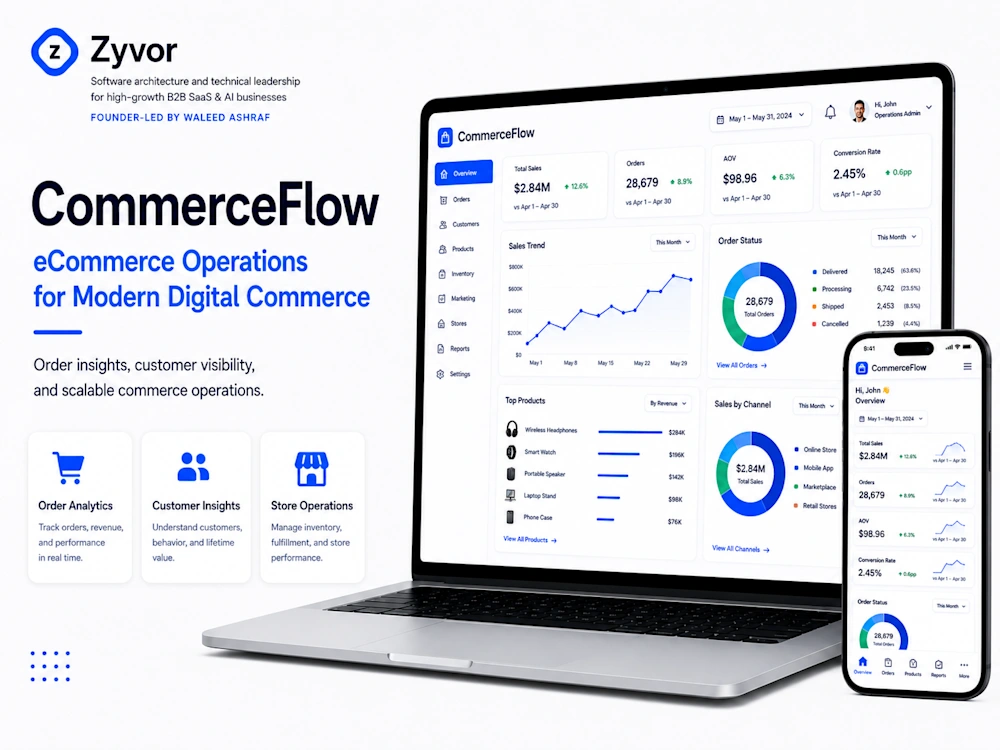
CommerceFlow

Multi-vendor eCommerce platform designed for product catalog management, vendor onboarding, order processing, inventory synchronization, and payment disbursement across multiple product categories.

CommerceFlow project cover
AlahdeenSep 1, 2023 – Dec 31, 2023

measurable outcomes

Vendor onboarding dropped from 12 business days to under 1 hour. Product listing quality issues reduced 82% through automated validation
"Ordered but out of stock" complaints dropped from 85/week to under 5. Inventory accuracy hit 99.4% across 120+ vendors
Order processing time dropped from 4-8 hours to under 30 seconds. Multi-vendor order fulfillment accuracy hit 99.1%
Concrete result: 99.4% inventory accuracy. 99.1% fulfillment accuracy. Vendor complaints about payments dropped to zero. Platform serving 50K+ products across 120+ vendors

problem

What had to change.

Vendor onboarding required manual database entries, FTP credentials for product uploads, and a 14-step checklist managed in a shared Google Doc. Average time from vendor signup to first product listed: 12 business days
Product catalog had no standardized schema. Each vendor uploaded data in their own format. 30% of product listings had missing images, incorrect categories, or broken descriptions
Inventory sync was a nightly batch job. Products sold out during the day still showed as available until midnight. Customer complaints about "ordered but out of stock" averaged 85 per week
Order routing to the correct vendor was semi-manual. A fulfillment coordinator reviewed every order and forwarded it to the right vendor via email. Processing time: 4-8 hours per order
Payment disbursement to vendors happened monthly via manual bank transfers. Reconciliation took 3 days per cycle. Vendors complained about delayed payments and opaque fee calculations
The platform crashed twice during holiday sales when concurrent users exceeded 2,000. Each outage lasted 3+ hours and cost an estimated $40K in lost revenue

execution

The implementation lanes behind the project.

From 12 business days to 45 minutes.

Automated Vendor Onboarding Pipeline

  • Self-service vendor portal with guided product upload, automatic image validation, and category mapping suggestions based on product descriptions
  • Standardized product schema with validation rules catching missing fields, incorrect formats, and duplicate listings before publication
  • Automated storefront generation: vendor gets a branded sub-page with product grid, filters, and reviews within minutes of completing onboarding
Vendor onboarding dropped from 12 business days to under 1 hour. Product listing quality issues reduced 82% through automated validation

No more selling products that don't exist.

Real-Time Inventory Synchronization

  • Webhook-based inventory updates from vendor systems with sub-5-second propagation to the storefront
  • Automatic listing deactivation when stock hits zero, reactivation when restocked, with customer waitlist notifications
  • Multi-warehouse support with location-aware stock allocation for vendors operating from multiple fulfillment centers
"Ordered but out of stock" complaints dropped from 85/week to under 5. Inventory accuracy hit 99.4% across 120+ vendors

Every order reaches the right vendor in seconds, not hours.

Intelligent Order Routing

  • Automatic order splitting for multi-vendor carts with parallel routing to each vendor's fulfillment queue
  • Vendor-specific SLA tracking with escalation alerts when fulfillment exceeds committed timeframes
  • Real-time order status updates flowing from vendor systems back to the customer-facing order tracker
Order processing time dropped from 4-8 hours to under 30 seconds. Multi-vendor order fulfillment accuracy hit 99.1%

Vendors paid accurately, on time, every time.

Automated Payment Disbursement

  • Stripe Connect integration with automatic commission calculation, fee deduction, and vendor payout scheduling
  • Real-time earnings dashboard for vendors showing sales, fees, pending payouts, and transaction history
  • Automated reconciliation replacing the 3-day manual process with instant settlement reports
Vendor payment cycle shortened from monthly to weekly. Reconciliation time dropped from 3 days to zero. Payment-related vendor complaints eliminated

Find the right product across 120 vendors in 2 keystrokes.

Scalable Product Discovery

  • Unified search across all vendor catalogs with faceted filtering by category, price, vendor rating, shipping speed, and availability
  • Personalized product recommendations based on browsing history, purchase patterns, and category affinity
  • Vendor comparison on shared products showing price, rating, shipping time, and return policy side by side
Search-to-purchase conversion improved 34%. Average session depth increased from 3.2 to 5.8 pages. Cross-vendor discovery drove 22% of all purchases

Make the implementation usable after launch.

Architecture Handoff and Operating Model

  • Documented the key architecture decisions, tradeoffs, and ownership boundaries behind the work.
  • Connected delivery lanes to support, operations, and future product iteration instead of treating launch as the finish line.
  • Gave the team a clearer operating model for scaling the product without recreating the same bottlenecks.
99.4% inventory accuracy. 99.1% fulfillment accuracy. Vendor complaints about payments dropped to zero. Platform serving 50K+ products across 120+ vendors

project depth

More context behind the CommerceFlow work.

Each selected project is read through business pressure, architecture tradeoffs, delivery sequencing, team operating model, role coverage, and stack fit so the case study stays useful for founders, CTOs, and product leaders evaluating similar work.

business pressure

Why the work mattered

The marketplace was growing despite its infrastructure, not because of it. The project started from a real operational constraint, not a decorative rebuild, which made the architecture work accountable to business movement.

architecture pressure

PostgreSQL with tenant-scoped schemas over separate databases

120+ vendors need data isolation without 120 database instances. Schema-per-vendor with shared infrastructure tables (orders, payments, search index) keeps queries fast and operations manageable

implementation priority

Automated Vendor Onboarding Pipeline

Vendor onboarding dropped from 12 business days to under 1 hour. Product listing quality issues reduced 82% through automated validation

operating change

What changed for the team

Vendor onboarding dropped from 12 business days to under 1 hour. Product listing quality issues reduced 82% through automated validation

role coverage

Leadership and engineering coverage

The work called for software architect, technical lead, full-stack engineer, backend engineer, api engineer coverage, connecting strategy, implementation, and delivery quality instead of treating them as separate tracks.

stack fit

Technology choices in context

Laravel, Next.js, PostgreSQL, Stripe, React, Node.js were part of the delivery context, but the value came from how the stack supported maintainability, scalability, and a stronger path from architecture to production.

architecture decisions

Technical choices that mattered.

PostgreSQL with tenant-scoped schemas over separate databases

120+ vendors need data isolation without 120 database instances. Schema-per-vendor with shared infrastructure tables (orders, payments, search index) keeps queries fast and operations manageable

Stripe Connect over custom payment ledger

Multi-vendor payment splitting, tax reporting, and vendor payouts are solved problems. Building a custom ledger would have added 6+ weeks and ongoing compliance burden. Stripe handles PCI, 1099s, and international payouts

SQS for order routing over synchronous processing

Multi-vendor cart splits generate parallel fulfillment events. SQS ensures every vendor receives their order even if one vendor's webhook endpoint is temporarily down. Dead letter queues catch and retry failures

Next.js with edge caching for product pages

45,000 monthly buyers browsing 50K+ products. Edge-cached product pages with ISR serve sub-1-second loads. Dynamic elements (inventory count, pricing) hydrate client-side

operating model

Architecture changes were tied directly to how the software business would operate after launch.

Vendor onboarding dropped from 12 business days to under 1 hour. Product listing quality issues reduced 82% through automated validation
"Ordered but out of stock" complaints dropped from 85/week to under 5. Inventory accuracy hit 99.4% across 120+ vendors
99.4% inventory accuracy. 99.1% fulfillment accuracy. Vendor complaints about payments dropped to zero. Platform serving 50K+ products across 120+ vendors

results

What changed after the work.

Vendor onboarding dropped from 12 business days to under 1 hour. Product listing quality issues reduced 82% through automated validation
"Ordered but out of stock" complaints dropped from 85/week to under 5. Inventory accuracy hit 99.4% across 120+ vendors
Order processing time dropped from 4-8 hours to under 30 seconds. Multi-vendor order fulfillment accuracy hit 99.1%

Week 1

Vendor onboarding automated. First 8 vendors self-onboarded in under 1 hour each. Product listing quality issues dropped 82%

Week 2

Real-time inventory live. "Ordered but out of stock" complaints dropped from 85/week to 12 in the first 2 weeks

Month 1

Order routing fully automated. Processing time from 4-8 hours to under 30 seconds. Vendor payment cycle moved from monthly to weekly

Month 2

Search-to-purchase conversion up 34%. Cross-vendor discovery driving 22% of purchases. Platform handled 3x traffic spike during promotional event with zero downtime

Month 3

99.4% inventory accuracy. 99.1% fulfillment accuracy. Vendor complaints about payments dropped to zero. Platform serving 50K+ products across 120+ vendors

Final outcome

99.4% inventory accuracy. 99.1% fulfillment accuracy. Vendor complaints about payments dropped to zero. Platform serving 50K+ products across 120+ vendors

buyer relevance

Why this project belongs in Zyvor software architecture work.

Software architecture signal

CommerceFlow shows how architecture decisions can move from implementation detail into business leverage for e-commerce teams.

Technical leadership signal

The work connects software architect, technical lead, full-stack engineer responsibilities with delivery clarity, execution confidence, and a cleaner operating model.

Scale-readiness signal

99.4% inventory accuracy. 99.1% fulfillment accuracy. Vendor complaints about payments dropped to zero. Platform serving 50K+ products across 120+ vendors

What kind of business is CommerceFlow most relevant for?

This project is most relevant for e-commerce and e-commerce teams that need stronger software architecture, clearer technical direction, and more reliable execution as product or operational complexity increases.

What did Zyvor focus on in this selected work?

I rebuilt the marketplace as a purpose-built multi-vendor platform with automated vendor onboarding, real-time inventory, intelligent order routing, and automated payment disbursement. Designed to handle 10x current volume without architectural changes. The work was framed around practical architecture decisions, delivery ownership, and measurable business outcomes rather than advisory language alone.

How does this support Zyvor's software architecture consulting focus?

CommerceFlow supports Zyvor's focus on B2B SaaS and AI software architecture consulting by connecting system design, technical leadership, scalability, and execution quality to a concrete project outcome: 99.4% inventory accuracy. 99.1% fulfillment accuracy. Vendor complaints about payments dropped to zero. Platform serving 50K+ products across 120+ vendors

What kind of technical leadership problem does this represent?

It represents the point where delivery pressure, architecture ownership, and business expectations start converging. In work like CommerceFlow, technical leadership is not only about writing code; it is about choosing the right sequence, reducing ambiguity, and giving the team a clearer execution model.

What should a founder or CTO notice in this project?

A founder or CTO should notice the link between the business problem and the technical system underneath it. The most important signal is not a tool choice by itself; it is how the architecture, implementation lanes, and operating model support a measurable business result.

Does this kind of work require a full rebuild?

Not always. The right engagement depends on where the risk sits. Some projects need a focused architecture reset, some need modernization, and some need new product development. Zyvor frames the work around the smallest practical path to stronger scalability, reliability, and delivery confidence.

Decision context

The marketplace was growing despite its infrastructure, not because of it. That business pressure shaped the architecture choices, implementation order, and operating model behind the work.

Delivery leverage

Vendor onboarding dropped from 12 business days to under 1 hour. Product listing quality issues reduced 82% through automated validation This is the kind of delivery leverage Zyvor looks for: fewer bottlenecks, clearer ownership, and better execution rhythm.

Architecture handoff

The project covered Laravel, Next.js, PostgreSQL, Stripe, React while keeping the handoff focused on maintainability, future change, and leadership clarity instead of isolated implementation tasks.

Best-fit conversation

A similar engagement usually starts with the current bottleneck, the architecture decision that feels stuck, and the business risk that is becoming harder to ignore.