
Marketplace Architecture Foundation Case Study
A marketplace SaaS architecture case study highlighting booking lifecycle design, payment system structure, and scalable service boundaries for growth-ready platforms.
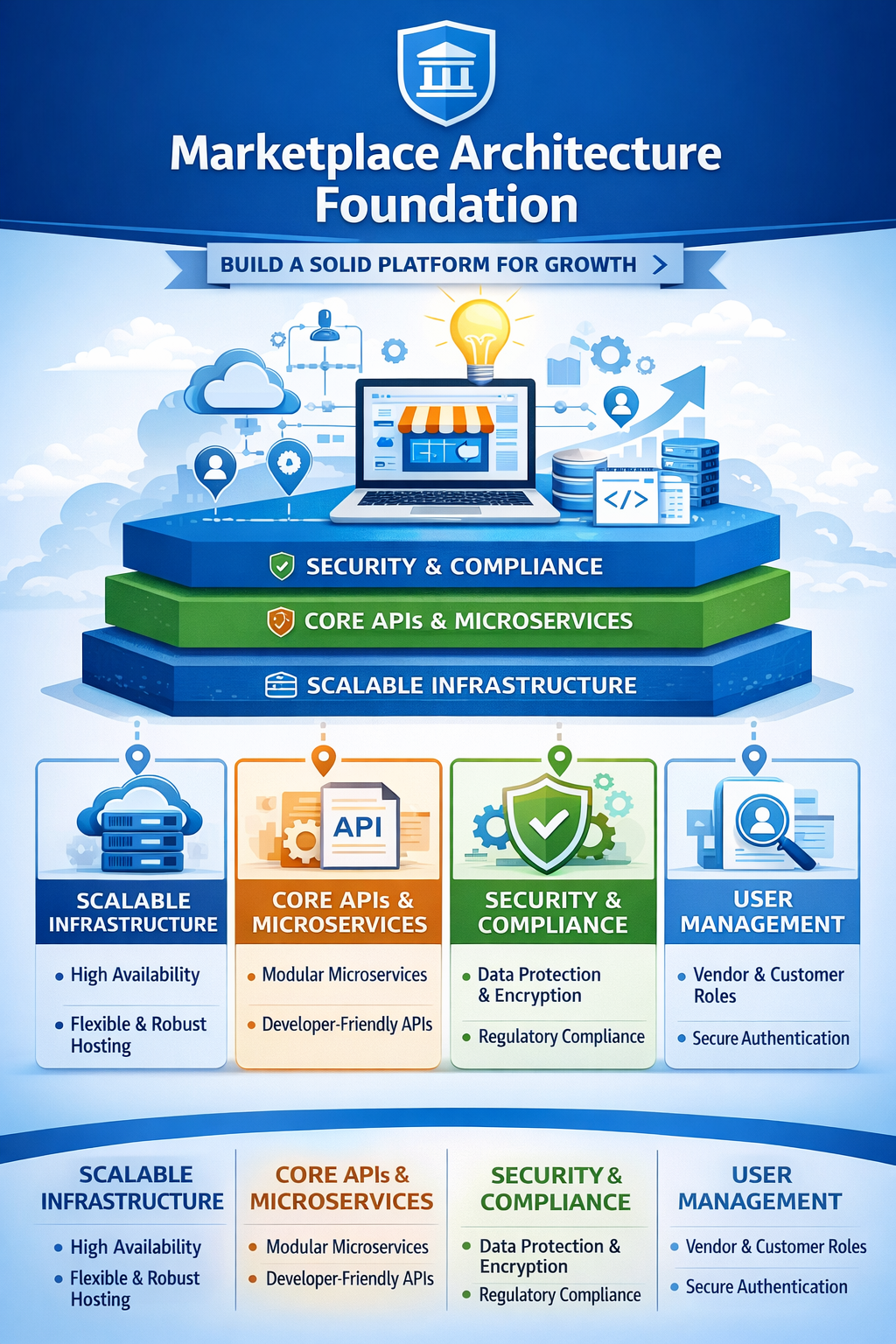
Marketplace Architecture Foundation
This marketplace architecture foundation engagement established a scalable baseline for a marketplace product: clear service boundaries, a reliable booking lifecycle, and a payment workflow designed to handle retries safely. The outcome was an execution-ready architecture that reduces rebuild risk and supports growth.
Note: Specific technical details are intentionally generalized to respect confidentiality. The engagement structure and outcomes reflect real architecture consulting work.
Context
A marketplace MVP needed a growth-ready foundation for booking and payments. The team required a marketplace architecture foundation that could scale without over-engineering: predictable booking state transitions, resilient payment handling, and clear boundaries to avoid early coupling.
The Challenge
- Define clean architectural boundaries early (to avoid tight coupling).
- Design the booking lifecycle with safe state transitions (state machine thinking).
- Prevent payment duplication and inconsistent failure handling (idempotency + reconciliation).
- Reduce rebuild risk while keeping delivery velocity during the growth phase.
What Zyvor Delivered
- Marketplace architecture blueprint (services, boundaries, responsibilities).
- Booking lifecycle model and state machine design.
- Idempotent payment handling strategy (retries + webhook reconciliation).
- Execution-ready guidance for the engineering team (sequencing + guardrails).
Core Decisions
Architecture Approach
The engagement started by mapping the end-to-end booking journey (search → reserve → confirm → fulfill → cancel/refund) and aligning each step with an explicit state transition. This avoids “hidden states” that usually cause support issues and inconsistent user experiences. The marketplace architecture foundation then separated responsibilities into focused components: booking orchestration, payment processing, inventory/availability, and notifications.
For payments, the design emphasized correctness under retries. Webhooks, network timeouts, and double submissions are normal in real systems, so the architecture treated retries as a first-class scenario. This reduced duplication risk and ensured booking and payment records remain consistent even when third-party providers behave unpredictably.
Reliability Guardrails
- Idempotency keys for create/confirm payment actions to prevent duplicate charges.
- Webhook reconciliation to safely resolve delayed or out-of-order payment events.
- Booking state constraints so only valid transitions can occur (prevents edge-case corruption).
- Audit-friendly records for disputes, refunds, and customer support workflows.
Outcome
The product launched core booking and payments on a stable architecture, enabling confident growth and structured expansion. By establishing the marketplace architecture foundation early, the team reduced long-term risk and improved delivery predictability.
Frequently Asked Questions
What do you deliver in an architecture engagement?
A structured assessment and an execution-ready plan: service boundaries, booking/payment flow design, data/API strategy, risk areas, and prioritized next steps the team can implement.
How do you prevent payment duplication in marketplace systems?
Using idempotency keys, consistent transaction records, and webhook reconciliation so retries and failures resolve safely without duplicate charges.
Do you share confidential implementation details?
No. Case studies generalize specifics while preserving the engagement structure and outcomes.
References & Next Steps
For architecture patterns and scalable design thinking, review the Martin Fowler architecture resources and the AWS Well-Architected Framework. If you’re planning a marketplace MVP or improving payments reliability, explore Zyvor’s architecture consulting services or book a review call.